What Karat Is Dental Gold? Purity, Gold Content, and What It Means When You Sell
Dental gold has no single karat. Restorations are cast from alloys that are classified by noble-metal content rather than karat-graded, so the only honest karat figure is one worked back from the measured gold percentage. Here is how that conversion works, why colour and age cannot tell you the answer, and how the actual purity of your piece is determined.
Free prepaid, insured USPS shipping label and packing instructions, usually emailed the same business day.
Dental gold has no single karat. Crowns, bridges, inlays and onlays are cast from dental alloys that are classified by their noble-metal content, not graded in karats, and a readable karat mark cannot be assumed on them. The gold percentage varies from alloy to alloy, so the only honest karat figure for a dental restoration is a karat equivalent worked back from its measured gold percentage: gold percentage × 24 ÷ 100. A 40% gold alloy is 9.6 karat equivalent; an 80% gold alloy is 19.2 karat equivalent. The equivalent describes measured gold purity only: not every restoration contains gold, and a base-metal piece has no gold percentage to convert.
- Karat means parts of gold in 24. Pure gold is 24 karat; 18 karat is 75% gold; 14 karat is 58.3% gold.
- Dental alloys are classified as high noble, noble or predominantly base by their gold and platinum-group content. Those classes set minimum requirements; they do not tell you the actual percentage of your piece.
- Colour, age and the type of restoration cannot establish purity. Yellow alloys vary widely in gold, and some white alloys contain gold while others contain none.
- The purity of your material is known only after it is melted and the melted material is analyzed by XRF. Your written report shows the gold percentage used.
- Offers are based on gold content only, never on a mark or an assumed karat.
To see how different purities change the figure at your own weight, use the dental gold value calculator. The final offer is determined after melting and assay.
What karat actually measures
Before answering what karat is dental gold, it helps to be precise about the word. Karat is a measure of gold purity expressed in twenty-fourths. The Royal Mint describes the carat of a product as "a 24-part ratio, with pure gold rated as 24 carat", and the World Gold Council puts it the same way: "24 carat is pure gold with no other metals", and 18 carat "contains 75 per cent gold and 25 per cent other metals". Every karat is one twenty-fourth of the metal by weight, so the conversion is simple arithmetic in both directions.
| Karat | Parts gold in 24 | Gold by weight | Fineness |
|---|---|---|---|
| 24K | 24 / 24 | 100% (in practice 99.9%+) | 999 |
| 22K | 22 / 24 | 91.7% | 917 |
| 18K | 18 / 24 | 75% | 750 |
| 14K | 14 / 24 | 58.3% | 583 (585) |
| 10K | 10 / 24 | 41.7% | 417 |
| 9K | 9 / 24 | 37.5% | 375 |
Percentages are rounded to one decimal place. Fineness is the same purity written in parts per thousand, the form used in many hallmarks. Sources: Royal Mint, "Metal Fineness Explained"; World Gold Council, "About Gold Jewellery".
One spelling point, because searches arrive both ways: in American usage karat (K) is gold purity and carat (ct) is gemstone weight, while British usage spells both carat. "How many carats is dental gold?" is the same question with a different spelling, and the answer below applies to both.
Why there is no single answer to what karat is dental gold
Jewelry is generally made to a stated karat and marked with it. In the United States that marking is a jewelry-trade convention set out in the Federal Trade Commission's Jewelry Guides, which allow an alloy to be described as "Gold" only when the word is "immediately preceded by a correct designation of the karat fineness of the alloy" (16 CFR § 23.3). A ring is therefore 10K, 14K or 18K by design, and stamped accordingly.
Dental restorations are made differently. A dental laboratory casts a crown from an alloy chosen for how it casts, fits, wears and bonds to porcelain, and alloys are sold in many formulations. The profession classifies them by noble-metal content rather than by karat. The American Dental Association's materials for indirect restorations resource gives the ADA Council on Scientific Affairs' 2003 classification: high noble alloys contain at least 60% gold and platinum-group metals with gold at least 40%; noble alloys contain at least 25% gold and platinum-group metals; and predominantly base alloys contain less than 25%. The same resource notes that the current standard for these materials, ANSI/ADA Standard No. 134 (ISO 22674), replaced the older casting-alloy standards.
None of these documents grades dental alloys in karats, and the FTC guides apply to jewelry industry products (16 CFR § 23.0), not to dental restorations. So a readable karat mark cannot be assumed on a crown or bridge, and if one is present it describes the alloy as sold, not the composition measured after melting.
So when someone asks what karat is dental gold and gets four different answers on a forum, nobody is necessarily wrong. One person's crown may have been cast from a high-gold alloy, another's from a palladium-based noble alloy with little gold, a third's from a base-metal alloy with a gold-coloured surface. There is no universal karat because there is no universal alloy.
Classification is a threshold, not a measurement
This is the distinction that most online answers blur. The ADA classes are minimum requirements an alloy must meet to be labelled high noble or noble. They are not the measured composition of any particular restoration. A high noble crown must contain at least 40% gold, which is 9.6 karat equivalent as a floor, but an individual high noble alloy might contain 50%, 70% or more. A noble alloy must contain at least 25% noble metal, and that noble metal can be mostly palladium with very little gold. Knowing the class a crown was sold under tells you the lowest gold percentage it could have, not the percentage it does have.
| ADA class (2003) | Requirement | What it implies about karat |
|---|---|---|
| High noble | Gold and platinum-group metals ≥ 60%, gold ≥ 40% | Gold is at least 40%, so at least 9.6K equivalent. The actual figure can be much higher |
| Noble | Gold and platinum-group metals ≥ 25% | No minimum gold content is set. Gold may be a large share, a small share, or absent in a palladium-based alloy |
| Predominantly base | Gold and platinum-group metals < 25% | No gold minimum is set. Gold may be present in a small amount or absent |
Classification: ADA Council on Scientific Affairs, 2003, as reproduced on the ADA's "Materials for indirect restorations" page (archived reference material). The karat-equivalent column converts the gold requirement only; the combined gold-and-platinum-group thresholds are not karat figures and are not converted. None of it is a measured value for any restoration.
Converting gold percentage to karat, and back
Because dental gold is not karat-graded, the useful question is not what karat is dental gold marked as, but what karat its measured gold percentage is equivalent to. A karat equivalent describes measured gold purity and nothing else; a restoration that contains no gold has no equivalent. The formulas are:
- Karat equivalent = gold percentage × 24 ÷ 100
- Gold percentage = karat × 100 ÷ 24
| Gold by weight | Karat equivalent | Comparable jewelry karat |
|---|---|---|
| 25% | 6.0K | Below any standard jewelry karat |
| 40% | 9.6K | Just under 10K (41.7%) |
| 50% | 12.0K | Between 10K and 14K |
| 58.3% | 14.0K | 14K |
| 60% | 14.4K | Just over 14K |
| 70% | 16.8K | Between 14K and 18K |
| 75% | 18.0K | 18K |
| 80% | 19.2K | Between 18K and 22K |
| 91.7% | 22.0K | 22K |
Arithmetic only. These rows are conversions, not a statement of what any dental alloy typically contains. A common shorthand says that 40% to 80% gold "equals 10 to 18 karat"; the exact equivalents are 9.6 and 19.2 karat.
Two cautions on reading what karat is dental gold from a percentage. First, the conversion describes the gold alone. A 60% gold dental alloy is 14.4 karat equivalent for its gold, but the remaining 40% may include platinum or palladium, metals that a 14K jewelry alloy would not normally contain. Second, the equivalent is only as good as the percentage behind it, and for a piece in your hand that percentage is unknown until it is measured.
Why colour, age and restoration type cannot tell you the karat
People asking what karat is dental gold usually have a specific object in front of them and are hoping to read the answer off it. Three shortcuts look tempting, and none of them works.
- Colour. The yellow of a gold alloy comes mainly from the mixture of gold, copper and silver, and alloys with very different gold percentages can look much the same. White and grey restorations are no guide either: a white high-palladium alloy can be a noble alloy with gold in it, while a silver-coloured base-metal crown contains none. Our guide to white dental gold covers the silver-coloured alloys in detail.
- Age. Older restorations are often assumed to be higher in gold. Alloy choice depends on the laboratory and the clinical case, not simply on the decade, and an older crown can be base metal just as a recent one can be high noble. The age of a piece is not a measurement of anything.
- Restoration type. A full-cast crown, an inlay, a bridge and the metal under a porcelain-fused crown can each be made from any class of alloy. A porcelain-fused-to-metal crown may hide a high-gold coping or a base-metal one behind the same ceramic. Type tells you the shape of the metal, not its purity. For bridges specifically, see how to sell dental bridges.
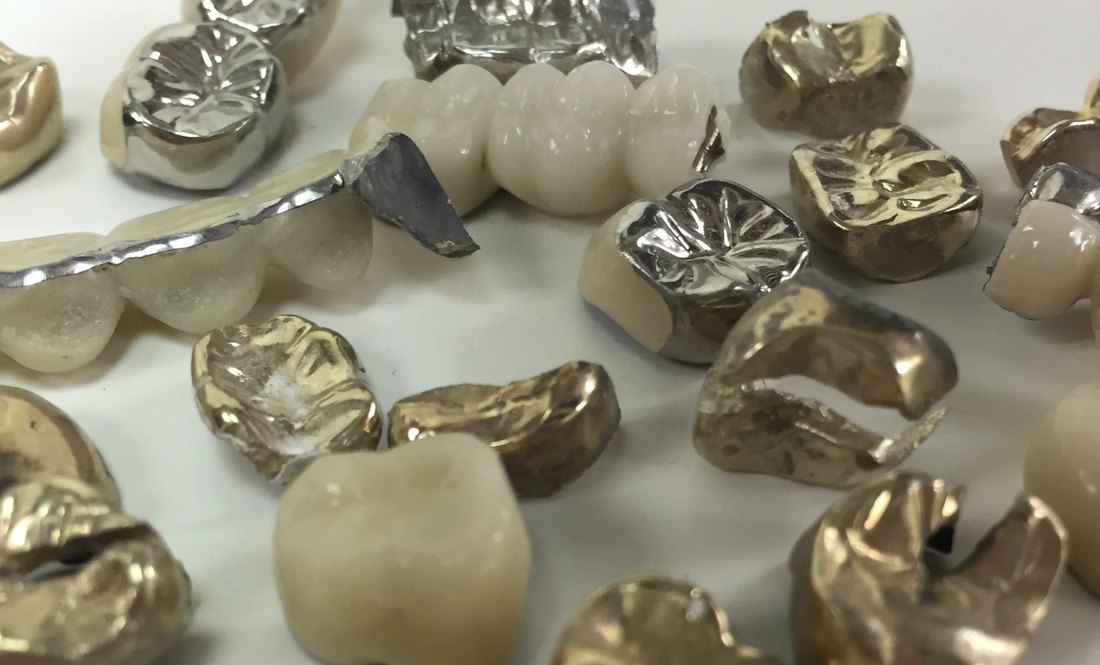
There is usually no mark to fall back on either. Dental castings sit outside the jewelry hallmarking and karat-marking conventions, so a readable karat mark cannot be assumed, and the shortcut that works for a ring generally does not exist here. For the signs that do help you judge whether a piece is worth sending, see how to identify dental gold. And you do not have to decide before you send anything: send pieces you are unsure about, because base metal pieces add no gold and offers are based on gold content only.
How the gold percentage of your piece is actually determined
At Dental Gold Experts the answer to what karat is dental gold is measured rather than guessed. Everything you submit is melted together as one lot, and Blake analyzes multiple spots on the melted material by XRF to determine its gold content. Melting matters: a restoration is a mixture of alloy, cement, porcelain and sometimes tooth structure, and a surface reading of an unmelted crown can describe its surface rather than the whole metal. We sort your material and remove as much non-metal material as practical before weighing and melting, and payout calculations use the post-melt weight.
The result is a gold percentage for the lot, and that figure appears in your written report alongside the weight, the gold spot price used, the payout rate and the payout calculation. If you want the karat equivalent, multiply that percentage by 24 and divide by 100; the report gives you the number the conversion needs. The process is described step by step in how we assay dental gold and the dental gold assay process.
A question I hear often is some version of "is it 14 karat or 18?" and the honest answer is that nobody can tell you from the outside, including me. Yellow alloys vary widely in gold content, and some contain very little. That is why everything goes into the crucible as one lot and I read multiple spots on the melted material by XRF. The percentage in your written report is what the metal actually was, and your offer is worked out from that.
What purity means for value
Once you know what karat is dental gold equivalent to for your lot, purity becomes one of three inputs. The value of the gold in a lot is the post-melt weight, multiplied by the gold percentage, converted to troy ounces, multiplied by the gold spot price shown in your written report. A higher karat equivalent means more gold in every gram, but a small high-gold crown and a larger lower-gold bridge can contain similar amounts of gold, so weight and purity have to be read together.
- Assume the metal recovered from a lot weighs 3 grams after melting.
- Assume the melted material tests at 60% gold, which is 14.4 karat equivalent. Gold content: 3 g × 0.60 = 1.8 g of gold.
- Convert to troy ounces: 1.8 g ÷ 31.1035 = 0.0579 troy oz.
- Assume a gold spot price of $4,000 per troy ounce (a round figure chosen for the arithmetic; it is not today's price and not a price Dental Gold Experts uses). Value of the contained gold: 0.0579 × $4,000 ≈ $231.
- Your offer is that gold value multiplied by the payout rate shown in your written report, so the offer is lower than the gold value.
Every figure above is assumed for illustration: the weight, the gold percentage and the spot price alike. Gold spot prices change daily; you can compare published prices from sources such as Kitco or the LBMA. Your actual offer uses the post-melt weight, the gold percentage measured by XRF, and the gold spot price shown in your written report.
At that same assumed $4,000 per troy ounce, the table below shows how the gold value of a single gram of melted metal changes with purity, so you can see what each karat equivalent is worth per gram under the same illustrative assumption.
| Gold by weight | Karat equivalent | Gold in 1 g of metal | Gold value per gram (assumed $4,000/oz) |
|---|---|---|---|
| 40% | 9.6K | 0.40 g | ≈ $51 |
| 60% | 14.4K | 0.60 g | ≈ $77 |
| 80% | 19.2K | 0.80 g | ≈ $103 |
Illustrative only. Each row is 1 g × gold percentage ÷ 31.1035 × the assumed $4,000 per troy ounce, rounded to the dollar. The offer is the gold value multiplied by the payout rate shown in your written report. Dental Gold Experts pays for gold content only; platinum, palladium and silver in the alloy are not paid for.
To run the same arithmetic with your own estimated weight and purity, use the dental gold value calculator. If you are weighing up whether a small amount is worth sending at all, is dental gold worth selling? works through that question, and there is no minimum quantity; a single crown is welcome.
Stop Guessing the Karat. Have It Measured.
Request your free prepaid, insured USPS shipping label. Your material is melted, the melted material is analyzed by XRF, and your written report shows the gold percentage your offer is based on.
Sending dental gold to be tested, step by step
Get your free USPS shipping label
Request your label and we email a free prepaid, insured USPS shipping label and packing instructions, usually the same business day. Use a USPS Small Flat Rate Box, securely tape the outside edges, attach the label, and drop the box at any USPS location. For larger shipments, contact us before shipping to arrange additional coverage.
Melt, XRF, and written report
You sign a pre-melt agreement before anything is melted. Blake melts your material and analyzes multiple spots on the melted material by XRF. Your written report shows the weight, gold percentage, the gold spot price used, the payout rate, and the payout calculation.
Accept and get paid
If you accept, we issue payment within 24 hours, usually immediately, by Zelle, PayPal, check, or ACH bank transfer. Receipt depends on the payment method.
The prepaid USPS shipping label and the assay are free · No minimum quantity
Get Your Shipping Label →Dental Gold Experts is based in Houston, Texas, and buys from anywhere in the country by mail; pickup is available in Houston, San Antonio, and Central Texas. Material is usually processed the day your package arrives or the next day; packages received on a weekend are processed the next business day. The whole route is set out in how to sell dental gold.
For dental practices and labs
A practice or laboratory asking what karat is dental gold is usually looking at a container of mixed scrap: crowns of several alloys, bridge units, porcelain-fused copings, perhaps lab sweeps and grinding dust. No single karat describes that mixture, and no one needs to sort it by alloy before it is sent. Everything is melted together as one lot and the melted material is tested, so the lot's gold percentage is what the written report shows and offers are based on gold content only. Our guide for dental practices selling scrap covers lot handling, and how dental practices should handle precious metal scrap sets out record keeping.
Related questions about specific pieces
The karat question tends to arrive attached to a particular object. These guides take each one in turn: gold crowns, gold fillings, inlays and onlays, gold dentures and partial frameworks, and gold crowns still on extracted teeth. Whatever the piece, the same rule holds: what karat is dental gold is a question about the measured gold percentage, and the measurement happens after the melt.
Find Out the Actual Gold Content of Your Dental Gold
Request your free prepaid, insured USPS shipping label. Blake melts everything you submit as one lot, analyzes multiple spots on the melted material by XRF, and sends you a written report showing the weight, the gold percentage, the gold spot price used, the payout rate and the payout calculation. Payment is issued within 24 hours after you accept.
Get Your Shipping Label →Frequently Asked Questions
Verified Customer Reviews
Read what dental practices say about working with dental gold buyers they trust on Trustpilot.
Founded by Blake Plummer, a precious metals professional with 15+ years of experience buying, valuing, and refining gold.
Houston, Texas Based · Serving Dental Practices Nationwide
View Reviews on Trustpilot