How to Sell Gold Crowns: Value, Alloys, and How to Get Paid
Learn how to identify gold dental crowns, understand what they're worth, and maximize your payout through a professional melt-and-assay.
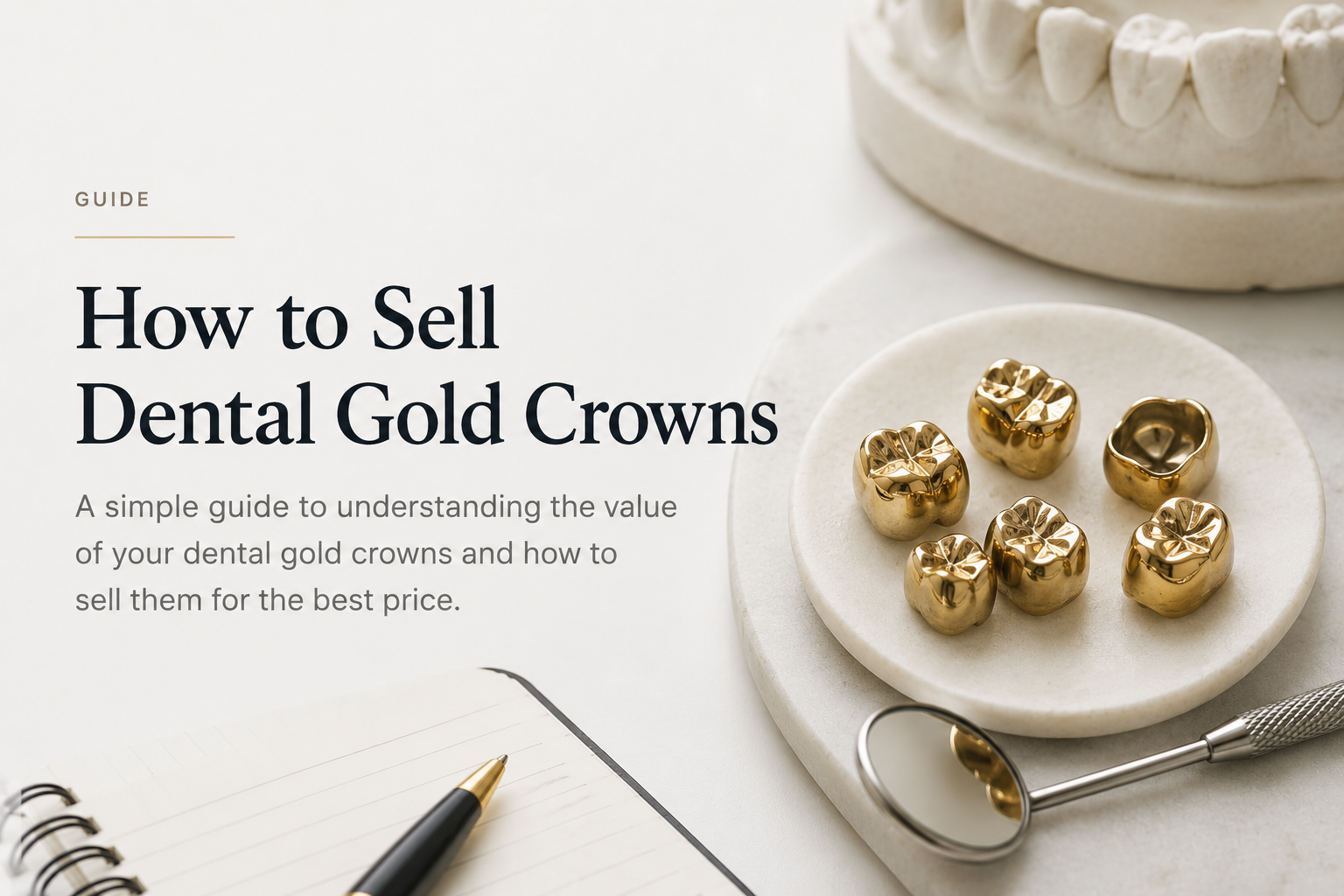
High-noble and noble alloy gold crowns — gold content varies significantly by era of fabrication, alloy classification, and crown weight
If you're looking to sell gold crowns, the most important thing to understand upfront is that many older crowns contain meaningful amounts of gold and other precious metals — value that holds real recoverable worth at current spot prices. Most gold dental crowns placed before the mid-1990s were cast from high-noble gold alloys, which served as the clinical standard for durable restorations at the time. That means a crown that's been sitting in a drawer or a specimen cup for years may represent real recoverable gold, even if it doesn't look valuable at a glance.
This guide covers everything you need to know about selling gold crowns: which alloys contain the most gold, how to tell if your crown is made of gold, realistic value expectations by crown type, and how to get the best outcome through a professional melt-and-assay evaluation.
If you're selling more than a single crown, you may also want to learn about selling dental bridges, selling dental gold, and our complete guide on how the dental gold selling process works.
per gold crown
in gold crowns
crown alloy
valuation method
Only a professional melt-and-assay can determine the exact precious metal content and true value of an individual gold crown. Color, visual inspection, and general gold buyer XRF devices cannot accurately identify or price the full alloy composition of dental gold.
What Is a Gold Dental Crown Actually Made Of?
Before you can understand gold crown value, you need to understand what's inside. Dental gold is not the same as jewelry gold. A 24-karat gold ring is nearly 99.9% pure gold — soft, bright yellow, and not suitable for a tooth. Dental crowns are engineered for a different purpose: they need to withstand years of chewing force, temperature swings, and saliva exposure, which means they're cast from alloys, not pure gold. The American Dental Association classifies dental casting alloys into three tiers:
Au + PGM ≥ 40%
Minimal melt value
Don't discard
Older gold crowns — particularly those placed before the mid-1990s — were commonly cast from high-noble alloys because gold was the clinical standard before ceramic and zirconia alternatives became widespread. If someone hands you an old crown with yellow metal, it's worth assuming gold alloy until proven otherwise. Learn how a multi-unit version of the same alloy classification applies in our guide to selling dental gold bridges.
Gold crowns are just one type of recoverable dental precious metal. If you have multiple restorations, read our guide on selling dental gold to understand how crowns, bridges, fillings, and other dental alloys are professionally evaluated together.

A gold crown placed before 1995 is almost always worth examining closely. High-noble gold alloys were the default for many years. The shift toward base metals and full-ceramic happened gradually through the late 1990s and 2000s as dental labs looked to reduce material costs. When a crown crosses my evaluation table, my first assumption is gold — not the other way around. The color alone tells you a lot: a deeper, richer yellow points toward higher gold content, while a slightly paler cast often signals a different alloy mix.
How to Identify a Gold Dental Crown
Before you decide whether to sell or hold onto a crown, it helps to know what you're looking at. While appearance alone can't confirm exact metal content, there are visual clues that can tell you whether a piece is worth having professionally evaluated.
Yellow Gold Crowns
A crown with a warm yellow tone is the easiest to recognize. This color almost always points to a high-noble gold alloy, which is the most valuable category of dental casting alloy. If your crown looks like this, the answer to "is my crown made of gold?" is very likely yes — and it's worth evaluating rather than discarding.
White or Silver-Toned Crowns
Not all valuable crowns are yellow. A white or silver-colored crown can still be a noble alloy containing meaningful precious metal value. This is one of the most common reasons people mistakenly throw away a piece that's actually valuable — they assume "white" means "not gold," which isn't a safe assumption.
Porcelain-Fused-to-Metal (PFM) Crowns
PFM crowns look tooth-colored or white on the surface, but underneath the porcelain is a metal coping that's often cast from a gold alloy. So if you're wondering "is porcelain still valuable?" — the porcelain itself has no melt value, but the metal structure beneath it frequently does. Look closely at the edge near the gumline; a thin sliver of metal is often visible where the porcelain meets the margin.
Visible Metal Margins
One of the most reliable visual cues on any crown is the margin — the edge where the restoration meets the natural tooth or gumline. A visible metal line at this margin, even on an otherwise tooth-colored crown, is a strong sign that a metal substructure is present underneath.
Older Crown Alloys
Age is one of the most useful clues you have. Crowns placed before the mid-1990s were overwhelmingly cast in high-noble or noble alloys, since these were the clinical standard before base-metal and all-ceramic materials became widespread. If you know roughly when a crown was placed and it predates that shift, treat it as a strong candidate for evaluation.
Why Appearance Alone Isn't Enough
Color, shine, and weight can point you in the right direction, but none of these can confirm the exact alloy composition or gold percentage. Two crowns that look identical can have very different gold content depending on the lab and era that produced them. Consumer gold-testing tools and simple visual inspection are not reliable enough to price dental alloys accurately — they're built for simpler, single-metal items like jewelry, not the complex alloy mixtures used in dental casting.
So is your crown worth anything? If it contains any yellow or white metal — visible on the surface or just at the margin — the answer is usually yes, and it's worth finding out for certain. Should you throw it away? Not without having it looked at first. The only way to know the exact gold content, and therefore the real value, is a professional melt-and-assay evaluation.
If you're still unsure whether your restoration contains recoverable gold, our complete guide to identifying dental gold explains the visual characteristics of common dental alloys and what makes them valuable.
How Much Is a Gold Dental Crown Worth When You Sell It?
Gold crown value depends on three variables that move independently: the weight of the crown, the percentage of gold in the alloy, and the current spot price of gold on the open market. That's why there's no single fixed answer — and why a professional melt-and-assay provides a much more accurate assessment than appearance alone.
Here's the practical math. A typical gold dental crown weighs between 2 and 4 grams. High-noble alloys contain roughly 20-80% gold by weight. At gold prices that have traded above $4,000 per troy ounce in 2025-2026, a single crown with meaningful gold content is generally worth $50 to $175 or more in refined metal value — and crowns toward the top of the weight and purity range can exceed that. Many dental gold alloys also contain other precious metals that contribute to the final payout, making professional assay the only accurate way to determine value.
If you're planning to sell gold crowns, understanding their true value before accepting an offer can make a significant difference. Every crown is unique in weight, alloy composition, and gold content, which is why a professional melt-and-assay is the most accurate way to determine its worth.
| 🦷 Alloy Classification | ⚗️ Typical Gold % | 🔩 Composition Notes | 💰 Approx. Value Per Crown |
|---|---|---|---|
| High-Noble (pre-1990s) | 60-80% | Predominantly gold alloy | $100 – $200+ |
| High-Noble (1990s-2000s) | 40-60% | Mixed precious metal alloy | $75 – $160 |
| Noble (lower gold content) | 15-30% | Mixed alloy, lower gold share | $50 – $130 |
| PFM (coping only) | Varies by coping | Gold-based coping alloy | $30 – $100 |
| Base Metal (Ni-Cr, Co-Cr) | 0% | None | $0 – nominal |
Illustrative value ranges based on current approximate market conditions and a typical crown weight of 2-4 grams. Actual payout depends on live spot prices and precise assay results, and reflects a buyer rate of 70-90% of refined melt value.
A single gold crown sold to a reputable buyer will fetch a fair payout. But if you're a dental office or estate with 10, 20, or 50+ crowns, your leverage increases significantly. Larger lots justify formal assay, which eliminates estimation uncertainty entirely — and buyers can pass through better economics at higher volumes.
If you have multiple crowns to sell, accumulating them before selling generally works in your favor. The most accurate way to evaluate any gold crown, single or in bulk, is through a professional melt-and-assay — this process measures the actual gold recovered from the alloy, providing a precise basis for your offer.
Why Payout Is Not 100% of Melt Value When You Sell Gold Crowns
This question deserves a direct answer, because it trips up a lot of first-time sellers. Gold is trading above $4,000 per troy ounce — so why isn't a buyer paying that full rate on every gram of gold in your crown?
Because getting from "gold dental crown" to "refined gold at spot price" requires a processing chain with real costs. Dental alloys are complex mixtures of multiple metals: gold, silver, copper, and sometimes other elements. Before any of that material qualifies as refined metal tradeable at benchmark prices — which the LBMA sets globally — it has to go through professional melt-and-assay processing to separate each element. That process involves refining fees, assay costs, turnaround time, and market risk for the buyer between purchase date and settlement.
A reasonable buyer typically returns a majority of refined melt value, commonly in the 70-90% range, depending on volume, metal mix, and market conditions. An offer well below that range is worth questioning. Claims of paying 100% of melt value are also worth questioning, since the underlying processing costs are real and have to be accounted for somewhere.
I've seen sellers walk away from good offers because they fixated on the spot price number without accounting for refining. I've also seen sellers accept terrible offers because a buyer quoted a high "percentage of spot" on a made-up base figure. The only number that matters is the dollar amount you receive per gram or per piece — and whether it's calculated honestly against real current market prices. Ask any buyer to show you their math. If they can't or won't, that tells you everything you need to know.
How to Sell Gold Crowns: Step-by-Step
Whether you're a patient with a single removed crown, a dental office clearing accumulated restorations, or an estate handling a loved one's dental work, the process to sell gold crowns follows the same steps with Dental Gold Experts.
- 1Collect and Sort Your Pieces
Gather all the dental gold you have: crowns, bridges, partial dentures, gold fillings, or any other yellow or white metal restorations. PFM pieces are worth including even if you're not sure about their content. Set aside anything that's clearly full porcelain or white zirconia with no visible metal components.
- 2Don't Clean, Alter, or Sand the Crown
Leave the crown exactly as it is. Cleaning, filing, or sanding a dental crown before sale can reduce its weight and affect the visual cues experienced buyers use to assess alloy composition. Experienced dental gold buyers have evaluated thousands of crowns in all conditions.
- 3Request Your Free Prepaid USPS Shipping Label
We'll email you a prepaid USPS shipping label at no cost. Simply package your dental gold in any USPS Small Flat Rate Box, attach the prepaid label, and drop it off at your local USPS location. Your shipment is fully trackable throughout the process.
- 4Professional Evaluation
Blake Plummer evaluates your material by weight, alloy type, and professional assay where appropriate. Every submission is carefully assessed using current precious metal market prices.
- 5Receive Your Assay Report and Payment
You'll receive a detailed written assay report showing the precious metal content, current market pricing, and your payout. Payment is typically issued within 24 hours.
Get Your Free Prepaid USPS Shipping Label
Ready to sell your gold crowns? Request your free prepaid USPS shipping label today. Package your dental gold in any USPS Small Flat Rate Box, attach the label, and receive a professional written assay report with transparent pricing based on current market values.
Dental Offices: Sell Gold Crowns in Bulk for Better Rates
Every restorative dental practice accumulates precious metal scrap. When a crown is removed during a replacement procedure, when a patient never returns for their permanent restoration, when a lab remakes a crown and the original sits in storage — that material has real value that most offices never recover.
The economics of selling dental gold improve significantly with volume. A single crown gets a fair offer. A bag of 15 crowns justifies a formal assay, which eliminates estimation error and typically results in a higher payout percentage for the seller. As Dental Economics has documented, practices that systematize scrap recovery tend to recover more revenue over time than those that treat it as an occasional afterthought — the difference is process, not volume.
- Save every extracted metal crown. Yellow, white, silver, mixed — all of it. Don't sort, don't discard based on color. The metal substructure of a PFM crown can still contain meaningful gold content.
- Use a dedicated collection container. A simple labeled jar or zip bag in the operatory is all it takes. The workflow requires nothing more than dropping extracted crowns and removed restorations in the same place every time.
- Batch submissions periodically. There is no minimum quantity — but submitting a larger accumulated batch means one evaluation covers more material efficiently. Batching does not reduce per-unit value; each piece is assessed individually within the melt.
- Request a free prepaid USPS shipping label when you're ready to sell. Simply package your accumulated material in any USPS Small Flat Rate Box, attach the prepaid label, and mail it to Dental Gold Experts.
- Review the written assay report. Every submission comes with a complete breakdown showing gross weight, metal percentages, spot prices used, and the final offer calculation — chemistry behind it, not a guess.
Dental Gold Experts works with practices ranging from single-doctor offices to multi-location groups, and can structure recurring prepaid label arrangements that make gold recovery a consistent, low-effort revenue stream. At current gold prices, a year's worth of removed restorations from a moderate-volume restorative practice can represent several hundred to several thousand dollars sitting unclaimed in a drawer.
Practices that recover more than just crowns can benefit from our complete resource on selling accumulated dental gold, which covers crowns, bridges, inlays, onlays, partials, and other precious metal restorations.
Selling Gold Crowns from an Estate
Dental gold is frequently overlooked in estate administration. It's small, it doesn't look like obvious jewelry, and most estate executors have no frame of reference for its value. But a collection of removed crowns or a set of dental appliances from a deceased family member can be worth meaningful money — particularly if the person received significant dental work decades ago, when gold alloys were the standard restorative material.
Dental gold from estates doesn't require any special documentation to sell. It's scrap precious metal, and the transaction is straightforward. If you're handling an estate and find gold crowns among personal effects, treat them the same way you'd treat gold jewelry — they have market value, and a dental gold specialist will give you a more accurate assessment than a general estate buyer or jeweler.
Estate collections often include more than individual crowns. Our guide to selling dental gold explains how multiple types of restorations are evaluated together for maximum value.
Common Mistakes When You Sell Gold Crowns
Understanding what to avoid is just as important as knowing the process when you sell gold crowns. These are the mistakes that tend to cost sellers real money.
- Selling to a general pawn shop. Pawn shops are built around quick, low-risk transactions and rarely have the expertise to identify dental alloys or accurately calculate melt value for a complex precious metals piece. A well-intentioned pawn operator will typically default to a flat per-gram gold rate, applying a conservative gold percentage. You'll almost always leave money behind.
- Using a generic "cash for gold" mail-in service. These operations are designed for jewelry-grade assessment. Dental alloy composition is different from a 14-karat chain, and a buyer who doesn't specialize in dental materials won't evaluate it accurately.
- Discarding PFM crowns. Most people assume a tooth-colored crown is worthless. The metal coping underneath — hidden by the porcelain — is often cast from a gold alloy with real scrap value. Before you toss a PFM crown, have it evaluated.
- Accepting the first offer without context. Know approximate current gold spot prices before any conversation. Track them at Kitco or the World Gold Council. That baseline helps you evaluate whether an offer is genuinely fair.
- Cleaning, filing, or sanding the crown before sale. This affects both weight and evaluation accuracy. Leave the piece exactly as it is.
- Waiting without a reason. Precious metals prices fluctuate continuously. Holding dental gold indefinitely without a specific reason is simply unpaid risk. Get it evaluated and start the process — it costs you nothing to find out your number.
Avoid discarding a gold crown — yellow or white — without professional evaluation. White or silver crowns frequently contain meaningful precious metal value. The appearance of a crown is not a reliable indicator of its gold content or value.
Frequently Asked Questions: Selling Gold Crowns
Verified Customer Reviews
Read verified customer reviews on Trustpilot.
Founded by Blake Plummer, a precious metals professional with 15+ years of experience buying, valuing, and refining gold.
Houston, Texas Based · Serving Dental Practices Nationwide
View Reviews on Trustpilot