Can You Sell Gold Dentures? What Partial Denture Frameworks Are Worth
A complete acrylic denture has no gold in it. The value, when there is any, sits in the cast metal framework and clasps of a partial denture — and only when that metal is a gold alloy. Here is how to tell what you have, and how to mail it in with a prepaid, insured USPS label.
Free prepaid, insured USPS shipping label and packing instructions, usually emailed the same business day.
It depends entirely on what the denture is made of. A complete denture — the pink acrylic plate with acrylic or porcelain teeth — contains no gold and nothing a refiner can pay for. A cast partial denture is different: its metal framework and clasps are cast from a dental alloy, and when that alloy is gold-based you can sell gold dentures of that kind for the gold the metal contains. Dental Gold Experts buys gold dental alloy by mail from anywhere in the United States, with no minimum quantity. Offers are based on gold content only, measured after melting.
- Acrylic ("plastic") dentures and acrylic or porcelain denture teeth: no gold, no scrap value.
- Cast partial frameworks and clasps: sometimes gold alloy, often base metal. The metal is not marked.
- The value sits in that cast metal. The acrylic and the denture teeth are not paid for.
- Not sure which you have? Send pieces you are unsure about — base metal pieces add no gold, and offers are based on gold content only.
- Still assembled, with the acrylic and teeth attached? Contact us before shipping and we will confirm how to send it.
- Value depends on the post-melt weight, the gold percentage, the gold spot price shown in your written report, and the payout rate.
Before you sell gold dentures, you can put your own figures into the dental gold value calculator. The final offer is determined after melting and assay.
Which dentures contain gold, and which do not
"Denture" covers several different appliances, and they are not made of the same things. Before you can sell gold dentures you have to know which of them is sitting in front of you, because only some contain metal worth melting.
| What you have | What it is made of | Gold content |
|---|---|---|
| Complete (full) denture | Acrylic resin base with acrylic or porcelain teeth | None |
| Acrylic "flipper" or temporary partial | Acrylic resin, sometimes with a bent wire clasp | None in the acrylic; a wire clasp is normally base metal |
| Cast metal partial denture | A cast alloy framework and clasps, with acrylic and denture teeth attached | In the framework and clasps only — gold alloy in some, base metal in others |
| Partial with gold clasps on a base metal framework | Base metal framework, gold alloy clasps | In the clasps only |
| Gold crowns on the teeth that held the partial | Cast gold alloy | Yes — treat these as crowns |
The alloy used in any particular framework is not printed on it. Melting and assay is the only way to establish the gold percentage of your material.
Only the third and fourth rows give you something to sell. Gold dentures, in the sense people usually mean when they look for somewhere to sell gold dentures, are cast partials whose framework or clasps happen to be a gold alloy. If the gold is in crowns that came off the abutment teeth rather than in the partial itself, our guide to selling gold crowns covers those, and gold fillings, inlays and onlays are covered separately, and a crown still attached to an extracted abutment tooth is covered in gold crowns on extracted teeth. A fixed bridge is not a denture at all, although people often use the words loosely: see how to sell dental bridges.
Why most modern partial frameworks are not gold
Cast partial dentures have been made from both precious and base metal alloys for close to a century, and the balance has shifted decisively toward base metal. A published review of cobalt-chromium dental alloys records that the first known dental application of these alloys was in the 1930s, for the fabrication of removable partial denture frameworks, and that cobalt-chromium and nickel-chromium base-metal alloys "have become increasingly popular compared with conventional Type IV gold alloys, which were predominant metals previously used for RPD framework fabrication" — a shift the same review attributes to the rising cost of noble metals, and one that became more pronounced from the 1980s onward.
The American Dental Association's own materials guidance points the same way: in its materials for indirect restorations resource, cobalt-chromium alloys "are used primarily for removable partial dentures", while nickel-chromium alloys are "generally used for crowns and fixed partial dentures".
That resource also sets out the ADA Council on Scientific Affairs' 2003 classification of dental casting alloys by noble-metal content, which the ADA now keeps as archived reference material: high-noble alloys contain at least 60% gold and platinum-group metals with gold at least 40%; noble alloys at least 25%; and predominantly base alloys less than 25%. A gold-alloy partial framework sits in the upper classes. A cobalt-chromium one is a predominantly base alloy, with no gold to pay for — which is why the alloy, and not the appliance, decides what you can sell gold dentures for.
The practical consequence is worth knowing before you go any further: the older the partial, the better the chance its framework is a gold alloy — but age alone proves nothing, and neither does a yellow-looking clasp.
How to tell what your partial is made of
A few observations narrow it down. None of them replaces an assay, and you do not have to reach a conclusion first: you can send pieces you are unsure about.
- Colour of the metal. A distinctly yellow framework or clasp is a reason to have the piece assayed. Silver-grey metal is more likely to be cobalt-chromium, but white and grey dental alloys also include palladium- and platinum-based ones, so colour cannot settle it.
- The clasps versus the framework. Look at them separately. It was common practice to cast a framework in one alloy and use a different alloy for the clasps, so a partial can hold gold in one part and none in the other.
- Weight and feel. Gold alloys are considerably denser than cobalt-chromium, so a gold framework feels heavy for its size. This is a comparative impression, not a measurement.
- Markings. Dental appliances are not stamped with karat marks the way jewellery is. The absence of a stamp means nothing at all.
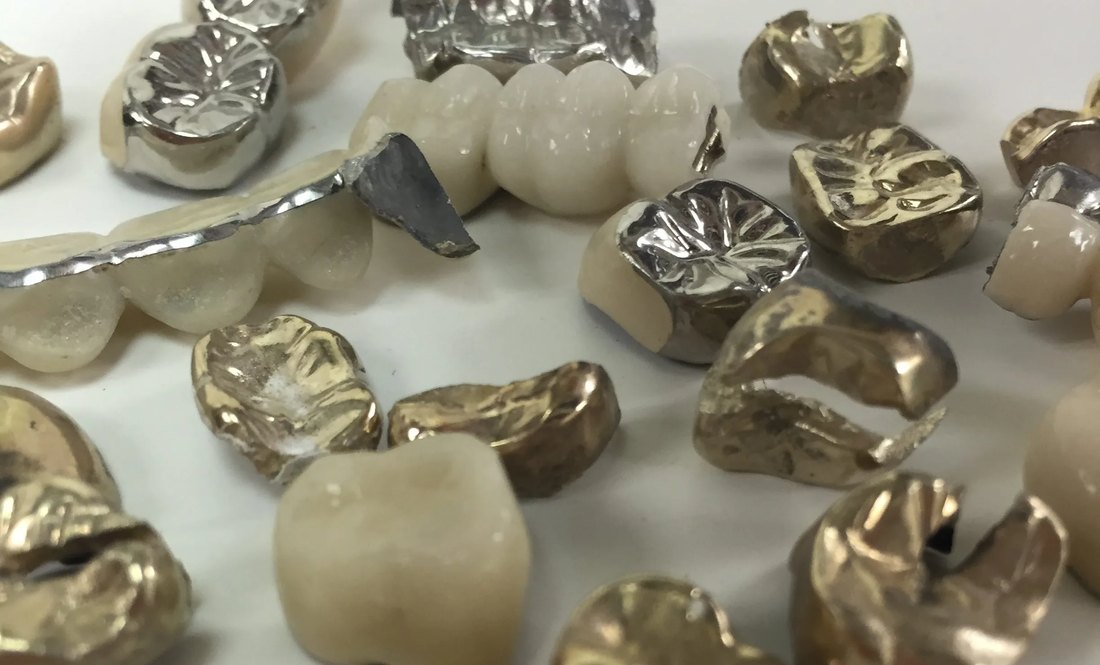
Those four checks are the most anyone can do by eye before they sell gold dentures, and none of them is conclusive. For photographs and a fuller walk-through of the visual signals, see how to identify dental gold. If the metal is white or grey and you want to understand what it might be, white dental gold explains those alloys — and states plainly that Dental Gold Experts pays for gold content only.
When someone calls and asks whether they can sell gold dentures, a partial is the one piece of dental work where I genuinely cannot answer over the phone. A cast framework is a cast framework — the yellow ones are sometimes base alloy with a warm finish, and I have seen plain grey-looking clasps come back rich. That is why I melt everything together as one lot and read the melted material by XRF. You get paid on the gold that is actually in there, and the written report shows you the number.
What can you sell gold dentures for?
There is no fixed price for a partial denture. Your offer is calculated from four things: the post-melt weight, the gold percentage, the gold spot price shown in your written report, and the payout rate. A cast framework holds more metal than a single crown does, so a gold-alloy partial can be one of the larger single pieces of dental gold an individual ever sends — but only the metal counts. The acrylic and the denture teeth are not paid for, and before weighing and melting we sort your material and remove as much non-metal material as practical.
If you send more than one item, everything you submit is melted together as one lot, and Blake analyzes multiple spots on the melted material by XRF to determine its gold content. Pieces are not valued separately, so anyone who sells gold dentures alongside a few crowns is paid on the gold in the whole lot rather than piece by piece.
- Assume the metal from a partial weighs 6 grams after melting.
- Assume the alloy is 60% gold. Gold content: 6 g × 0.60 = 3.6 g of gold.
- Convert to troy ounces: 3.6 g ÷ 31.1035 = 0.1158 troy oz.
- Assume a gold spot price of $4,000 per troy ounce (a round figure chosen for the arithmetic; it is not today's price and not a price Dental Gold Experts uses). Value of the contained gold: 0.1158 × $4,000 ≈ $463.
- Your offer is that gold value multiplied by the payout rate shown in your written report, so the offer is lower than the gold value.
Every figure above is assumed for illustration — the weight, the gold percentage and the spot price alike. A framework cast in cobalt-chromium would step 2 at zero. Gold spot prices change daily; you can compare published prices from sources such as Kitco or the LBMA. Your actual offer uses the post-melt weight, the gold percentage measured by XRF, and the gold spot price shown in your written report.
For an estimate using your own weight and estimated purity, use the dental gold value calculator. If you are weighing up whether the whole exercise is worth it, is dental gold worth selling? works through that question.
Find Out Whether Your Partial Holds Gold
Request your free prepaid, insured USPS shipping label, send the appliance as it is, and receive a written report with your offer. It is the simplest way to sell gold dentures without guessing at the alloy first.
Do you have to take the denture apart first?
No — and you should not try. Dental Gold Experts sorts the material and removes as much non-metal material as practical before weighing and melting, and the offer is based on the gold content of the metal, so dismantling an appliance yourself gains you nothing. If you want to sell gold dentures that are still assembled, with the acrylic and the denture teeth attached, contact us before shipping and we will confirm how to send them.
If you are sending a complete acrylic denture in the hope that something in it has value, it is worth saying plainly: there is nothing in an all-acrylic denture for a gold buyer. Acrylic resin is the major polymer used for making dental prostheses, and acrylic and porcelain denture teeth contain no gold either. Save yourself the trip to the post office unless there is cast metal involved: the framework and the clasps are the only parts that can carry any value.
Selling a denture that belonged to someone else
Old partials very often turn up while settling a relative's affairs, which raises a fair question about who may sell gold dentures that were never theirs to begin with. Dental Gold Experts buys from sellers who own the material or are authorized to sell it, so executors and family members can sell gold dentures found among a relative’s effects. Our guide to who owns extracted dental gold covers the questions that come up most often with inherited and estate material.
Where to sell gold dentures
Searches like "where can I sell used dentures" usually end in disappointment, because the appliance itself has no resale market: a denture is made for one person's mouth, and no dentist will fit a second-hand one. What does have a market is the metal, so the question is really where to sell gold dentures for the alloy in them — and the places worth approaching are the ones that buy dental metal by weight and assay rather than by appearance.
- A dental gold buyer or refiner, by mail. Dental Gold Experts buys nationwide using a free prepaid, insured USPS shipping label, melts your material, and reports what the melted material contained. There is no minimum quantity, so a single partial is worth sending, and you can sell gold dentures and loose crowns in the same box.
- A local pawn shop or jeweller. They will usually test the surface and make an immediate offer, without melting the piece or analyzing the melted material.
- Your dentist or dental lab. Practices and labs often accumulate scrap and send it in as one lot; see the section below if that is your situation.
If you would rather sell gold dentures in person than by mail, pickup is available in Houston, San Antonio, and Central Texas — contact us to discuss direct pickup options. Everywhere else in the United States, the mail route below is the one to use.
Sending your partial by mail, step by step
Here is the whole process, start to finish, for anyone ready to sell gold dentures by mail. It is the same three steps whatever dental gold you are sending.
Get your free USPS shipping label
Request your label and we email a free prepaid, insured USPS shipping label and packing instructions, usually the same business day. Use a USPS Small Flat Rate Box, securely tape the outside edges, attach the label, and drop the box at any USPS location. For larger shipments, contact us before shipping to arrange additional coverage.
Melt, XRF, and written report
You sign a pre-melt agreement before anything is melted. Blake melts your material and analyzes multiple spots on the melted material by XRF. Your written report shows the weight, gold percentage, the gold spot price used, the payout rate, and the payout calculation.
Accept and get paid
If you accept, we issue payment within 24 hours, usually immediately, by Zelle, PayPal, check, or ACH bank transfer. Receipt depends on the payment method.
The prepaid USPS shipping label and the assay are free · No minimum quantity
Get Your Shipping Label →Those three steps are the whole process, and they are the same whether you sell gold dentures, a handful of crowns, or a mixed box of old dental work. Dental Gold Experts is based in Houston, Texas, and serves customers nationwide by mail. Material is usually processed the day your package arrives or the next day; packages received on a weekend are processed the next business day. For the process end to end, see how to sell dental gold.
Partials and frameworks from a practice or lab
Practices and labs come across old cast partials during relines, remakes and extractions, alongside the crowns and bridges they already collect. Contact us before shipping if a partial is still assembled, so we can confirm how to send it. The same rules apply when a practice or lab wants to sell gold dentures as when an individual does: there is no minimum quantity, mixed material including pieces whose alloy nobody is sure about may be sent, and offers are based on gold content only. Our guide for dental practices selling scrap covers lot handling and record keeping.
Ready to Find Out What Your Partial Is Worth?
Request your free prepaid, insured USPS shipping label and sell gold dentures, crowns or any other dental gold the straightforward way. Blake melts your material, analyzes the melted material by XRF, and sends you a written report with your offer. Payment is issued within 24 hours after you accept.
Get Your Shipping Label →Frequently Asked Questions
Verified Customer Reviews
Read what dental practices say about working with dental gold buyers they trust on Trustpilot.
Founded by Blake Plummer, a precious metals professional with 15+ years of experience buying, valuing, and refining gold.
Houston, Texas Based · Serving Dental Practices Nationwide
View Reviews on Trustpilot