Can You Sell Gold Crowns on Extracted Teeth?
Yes — and you do not have to pry the crown off the tooth first. Your payout is based on the gold content of the recovered metal after melting, so here is what actually decides your offer, and why to contact us before you ship.
Free prepaid, insured USPS shipping label and packing instructions, usually emailed the same business day.
Yes. Dental Gold Experts accepts gold crowns on extracted teeth, and you do not have to get the crown off the tooth yourself. We sort your material and remove as much non-metal material as practical before weighing and melting. Your payout is based on the gold content of the recovered metal after melting. Tooth material does not contribute to the gold value. One thing to do first: contact us before shipping an extracted tooth, and we will confirm how to send it.
- With gold crowns on extracted teeth, the crown is what has value. Your payout is based on the gold content of the recovered metal after melting. Tooth material does not contribute to the gold value.
- No prying, cutting or cleaning on your part. Sending the crown still attached is fine.
- There is no minimum quantity; a single crown is welcome.
- Not sure the crown is gold at all? Send pieces you are unsure about — base metal pieces add no gold, and offers are based on gold content only.
- Your offer depends on the post-melt weight, the gold percentage, the gold spot price shown in your written report, and the payout rate.
- Contact us before you ship an extracted tooth. We do not publish handling or mailing instructions for teeth, so ask us rather than improvising.
To put your own figures in before you send anything, use the dental gold value calculator. The final offer is determined after melting and assay.
Why gold crowns on extracted teeth are accepted as they are
Gold crowns on extracted teeth turn up more often than people expect. A molar is extracted, the dentist hands it back in a little plastic tub, and months later somebody looks at it properly and notices the gold. Or a crowned tooth comes out on its own, root and all. Either way you end up holding one object made of two very different materials: a cast gold alloy cemented onto a piece of natural tooth.
Dental Gold Experts accepts gold crowns on extracted teeth exactly as they come, and buys them the same way loose crowns are bought — by the gold the metal contains, established by melting and assay rather than by appearance. There is no minimum quantity; a single crown is welcome, so a single tooth is a perfectly normal thing to send.
Why you do not have to remove the crown from the tooth
This is the question that stops most people who have gold crowns on extracted teeth, and the answer is genuinely reassuring: leave it alone. Before anything is weighed or melted, we sort your material and remove as much non-metal material as practical. Separating a crown from a tooth is routine work at that stage, and doing it yourself gains you nothing at all.
Your payout is based on the gold content of the recovered metal after melting. Tooth material does not contribute to the gold value. That is also why separating the two yourself gains you nothing: tooth structure, cement and porcelain do not survive melting as metal, so the figure only ever runs on the gold in the recovered alloy.
| Part of what you send | What it is | Does it affect your offer? |
|---|---|---|
| The gold crown | Cast dental alloy, gold in the noble and high-noble classes | Yes — this is what is paid for, on gold content |
| The natural tooth under it | Enamel, dentine, root | No. It contributes no gold value |
| Cement holding the two together | Dental cement | No |
| Porcelain on a metal-backed crown | Ceramic fused to a metal substructure | No, but the metal underneath may hold gold |
| An amalgam filling in the same tooth | Silver-mercury amalgam | No. Amalgam is not a gold alloy and is not paid for |
Weighing happens after melting, so with gold crowns on extracted teeth the non-metal parts do not carry into the payout weight. We remove as much non-metal material as practical during sorting.
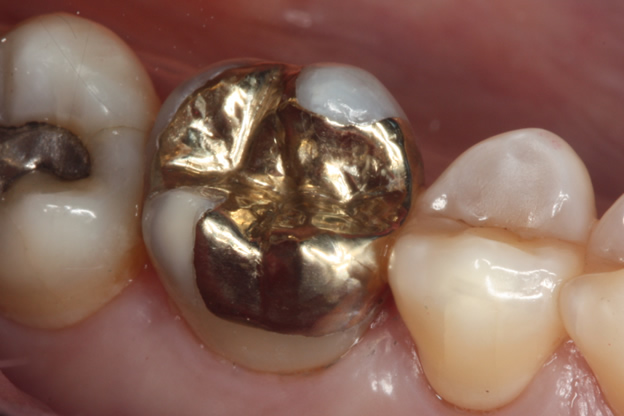
So the practical instruction is short. Do not chisel, grind, drill or boil anything. Do not try to crack the tooth to free the crown. Gold crowns on extracted teeth are sent as single objects, and the separation is our problem rather than yours.
How to tell whether the crown is actually gold
With gold crowns on extracted teeth, colour is a hint and nothing more. Dental alloys are made in a wide range of compositions, and the classification the profession uses is based on metal content rather than on looks.
The American Dental Association's materials for indirect restorations resource sets out the ADA Council on Scientific Affairs' 2003 classification of casting alloys, which the ADA now keeps as archived reference material: high noble alloys contain at least 60% gold and platinum-group metals with gold at least 40%; noble alloys at least 25%; and predominantly base alloys less than 25%. The same resource notes that high noble alloys "may be used for Type 3 high-stress crowns and onlays", which is the class a traditional full-cast gold crown belongs to.
Two consequences matter when you are looking at a tooth in your hand:
- A yellow crown is a reason to have it assayed, not proof of gold. Gold-coloured alloys vary widely in gold percentage, and the crown is not stamped with a karat mark. Dental work is not hallmarked the way jewellery is, so the absence of any marking tells you nothing.
- A silver or white crown is not automatically worthless. White and grey dental alloys include palladium- and platinum-based ones, and a porcelain-faced crown can hide a metal substructure. Our guide to white dental gold explains those alloys and states plainly that Dental Gold Experts pays for gold content only.
For photographs and a fuller walk-through of the signals to look for on gold crowns on extracted teeth, see how to identify dental gold. You do not have to reach a conclusion before you send anything: send pieces you are unsure about, and remember that base metal pieces add no gold.
People apologise to me for the tooth. They really do — they will ring up embarrassed that the crown is still stuck on a molar, as though they have sent me a problem. They have not. Gold crowns on extracted teeth are an ordinary day here. Everything a customer sends goes into the crucible as one lot and I read multiple spots on the melted material by XRF, so what the tooth was attached to never enters the number. You get paid on the gold that is actually there, and the written report shows you how it was worked out.
What gold crowns on extracted teeth are worth
There is no list price for a crown. Your offer is calculated from four things: the post-melt weight, the gold percentage, the gold spot price shown in your written report, and the payout rate. A full-cast gold crown is a small piece of metal, so gold crowns on extracted teeth usually mean a figure reflecting a few grams of alloy rather than a few ounces — and if the crown turns out to be a base-metal alloy with a gold-toned finish, there is no gold to pay for at all.
If you send more than one item, everything you submit is melted together as one lot, and Blake analyzes multiple spots on the melted material by XRF to determine its gold content. Pieces are not valued separately, so gold crowns on extracted teeth, two loose crowns and an old bridge all come back as one figure for the lot.
- Assume the metal recovered from one crown weighs 2 grams after melting.
- Assume the alloy is 60% gold. Gold content: 2 g × 0.60 = 1.2 g of gold.
- Convert to troy ounces: 1.2 g ÷ 31.1035 = 0.0386 troy oz.
- Assume a gold spot price of $4,000 per troy ounce (a round figure chosen for the arithmetic; it is not today's price and not a price Dental Gold Experts uses). Value of the contained gold: 0.0386 × $4,000 ≈ $154.
- Your offer is that gold value multiplied by the payout rate shown in your written report, so the offer is lower than the gold value.
Every figure above is assumed for illustration — the weight, the gold percentage and the spot price alike. A base-metal crown would stop at step 2 with nothing to carry forward. Gold spot prices change daily; you can compare published prices from sources such as Kitco or the LBMA. Your actual offer uses the post-melt weight, the gold percentage measured by XRF, and the gold spot price shown in your written report.
Note what is absent from that calculation for gold crowns on extracted teeth: the tooth itself. It has no step of its own, because it contributes no metal. For an estimate using your own weight and estimated purity, use the dental gold value calculator, and if you are weighing up whether the exercise is worth the trouble for one crown, is dental gold worth selling? works through that question.
Send It With the Tooth Still On
Request your free prepaid, insured USPS shipping label and ask us how to send an extracted tooth. Gold crowns on extracted teeth do not need to be taken apart first, and you receive a written report with your offer.
Contact us before you ship
One step comes before the post office: contact us before shipping gold crowns still attached to extracted teeth, and we will confirm how to send yours. Acceptance itself is settled — this material is bought, on gold content — but we do not publish handling or mailing instructions for extracted teeth, so ask us rather than improvising.
Everything else about selling gold crowns on extracted teeth runs as it does for any other dental gold. When you request your label, say that the crown is still on the tooth. We email a free prepaid, insured USPS shipping label and packing instructions, usually the same business day, you sign a pre-melt agreement before anything is melted, and then come the melt, the XRF reading and your written report.
Getting the tooth back from your dentist
You can only sell gold crowns on extracted teeth once the tooth is actually in your hands, so if it is still at the practice, ask for it — and ask before the appointment if you can, because that is far easier than asking after the fact. The same goes for a crown being replaced: if a dentist is removing an old gold crown to fit a new one, say explicitly that you would like the old restoration back.
On who is entitled to what, our guide to who owns extracted dental gold covers the questions that come up with inherited and estate material, and Dental Gold Experts buys from sellers who own the material or are authorized to sell it.
Where to sell gold crowns on extracted teeth
The market you want is the one that buys dental metal by weight and assay rather than by appearance, because an extracted tooth looks like nothing anyone would pay for and the gold on it is easy to undervalue by eye.
- A dental gold buyer or refiner, by mail. This is where gold crowns on extracted teeth belong. Dental Gold Experts buys nationwide using a free prepaid, insured USPS shipping label, melts your material, and reports what the melted material contained. Dental Gold Experts performs refining, including separating and purifying gold.
- A local pawn shop or jeweller. They will usually test the surface and make an immediate offer, without melting the piece or analyzing the melted material — which is harder to do usefully when the metal is still cemented to a tooth.
- Your dentist or dental lab. Practices and labs accumulate this material and send it in as one lot; see the section below if that is your situation.
If you would rather hand the material over in person, pickup is available in Houston, San Antonio, and Central Texas — contact us to discuss direct pickup options. Everywhere else in the United States, the mail route is the one to use. For a wider comparison of the options, selling dental gold sets out how the different buyers work.
Sending yours by mail, step by step
Once you have checked in with us about the tooth, gold crowns on extracted teeth follow the same three steps as any other dental gold shipment.
Get your free USPS shipping label
Request your label and we email a free prepaid, insured USPS shipping label and packing instructions, usually the same business day. Use a USPS Small Flat Rate Box, securely tape the outside edges, attach the label, and drop the box at any USPS location. Tell us the crown is still on the tooth and we will confirm how to send it. For larger shipments, contact us before shipping to arrange additional coverage.
Melt, XRF, and written report
You sign a pre-melt agreement before anything is melted. Blake melts your material and analyzes multiple spots on the melted material by XRF. Your written report shows the weight, gold percentage, the gold spot price used, the payout rate, and the payout calculation.
Accept and get paid
If you accept, we issue payment within 24 hours, usually immediately, by Zelle, PayPal, check, or ACH bank transfer. Receipt depends on the payment method.
The prepaid USPS shipping label and the assay are free · No minimum quantity
Get Your Shipping Label →Dental Gold Experts is based in Houston, Texas, and buys from anywhere in the country by mail. Material is usually processed the day your package arrives or the next day; packages received on a weekend are processed the next business day. For the process end to end, see how to sell dental gold.
Extracted teeth in a dental practice or lab
Dental Gold Experts accepts gold crowns on extracted teeth from practices and labs, alongside the crowns, bridges, lab sweeps, grinding dust and polishing waste they already collect, and offers are based on gold content only. Practices and labs follow their own handling procedures for this material, so contact us before shipping gold crowns still attached to extracted teeth from a clinical setting and we will confirm how to send them. Our guide for dental practices selling scrap covers lot handling and record keeping, and the scrap gold SOP sets out a written procedure.
Other dental gold you may have alongside it
An extracted tooth rarely turns up on its own. If you are going through a box of old dental work, these guides cover the rest of what tends to be in it: gold fillings, inlays and onlays, gold dentures and partial frameworks, and dental bridges. It all goes in the same box, and it is all melted as one lot — so there is no advantage in sending gold crowns on extracted teeth separately from everything else.
Find Out What the Gold in Your Crown Is Worth
Request your free prepaid, insured USPS shipping label, then contact us before shipping if the crown is still on the tooth and we will confirm how to send it. Blake melts your material, analyzes the melted material by XRF, and sends you a written report with your offer. Payment is issued within 24 hours after you accept.
Get Your Shipping Label →Frequently Asked Questions
Verified Customer Reviews
Read what dental practices say about working with dental gold buyers they trust on Trustpilot.
Founded by Blake Plummer, a precious metals professional with 15+ years of experience buying, valuing, and refining gold.
Houston, Texas Based · Serving Dental Practices Nationwide
View Reviews on Trustpilot