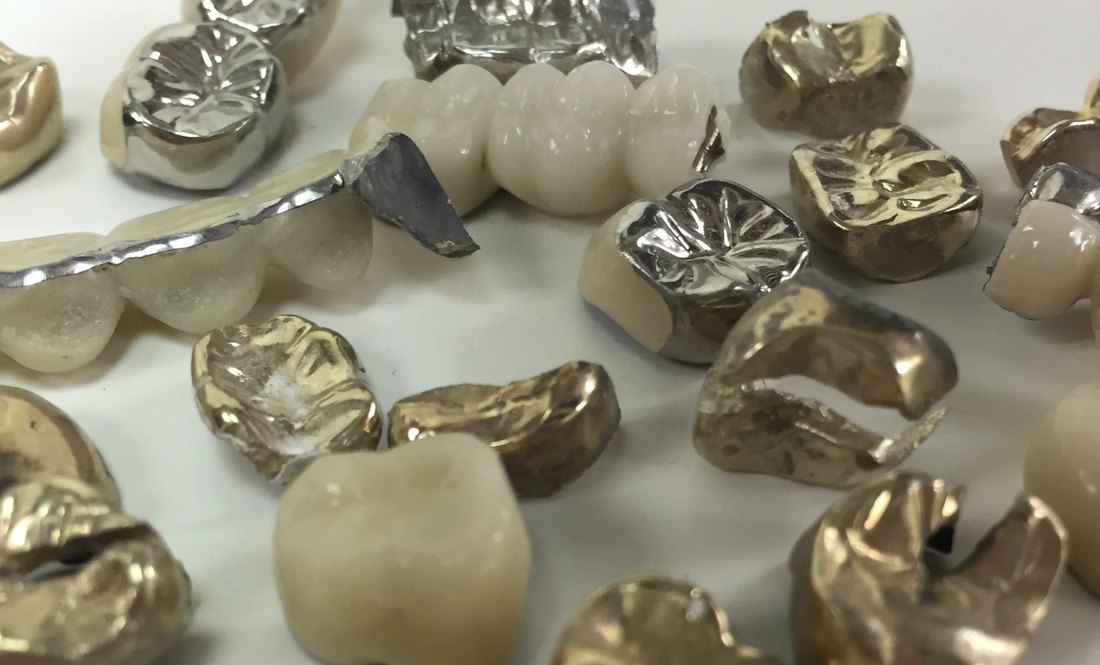
- What white dental gold actually is
- The three categories of silver-colored dental crowns
- ADA alloy classifications and what they mean for value
- Palladium and platinum in white dental alloys
- How to identify a potentially valuable white dental crown
- Why silver-colored crowns vary in gold content
- How offers on white dental gold are calculated
- Common misconceptions about white dental crowns
- Frequently asked questions
When most people hear "dental gold," they picture a yellow crown — a classic full-cast gold restoration with an unmistakable warm color. That yellow gold is easy to recognize and, for most buyers, easy to evaluate. But a large portion of dental precious metal restorations placed over the past four decades are not yellow. White dental gold — silver, white, or gray in appearance — confuses sellers, confuses general gold buyers, and is routinely discarded or undervalued as a result.
The term white dental gold is informal — it doesn't correspond to a single specific alloy or ADA classification. It describes a category of dental casting alloys that appear white or silver but may contain meaningful amounts of palladium, platinum, or gold-palladium combinations. Some of these alloys are genuinely valuable. Others, visually indistinguishable to an untrained eye, are predominantly base-metal alloys that may contain little or no gold.
This guide exists to close that knowledge gap. Whether you're a patient with a removed crown, a dental practice sorting accumulated scrap, or an estate administrator dealing with a collection of old restorations, understanding what white dental gold is — and what it isn't — is the difference between recovering real value and leaving money on the counter.
What White Dental Gold Actually Is
In the jewelry world, white gold is a specific product: yellow gold alloyed with white metals like nickel, palladium, or manganese, then often rhodium-plated to achieve a bright white finish. White dental gold is a different category with different metallurgical priorities — appearance matters, but the primary requirements are biocompatibility, castability, tarnish resistance, and bond strength for porcelain.
White dental gold casting alloys that produce a silver-colored restoration typically fall into one of two compositional families. The first is palladium-dominant alloys, where palladium — a platinum group metal — serves as the primary precious metal component. The second is platinum-containing alloys, used less commonly but present in older restorations. Both families can also contain meaningful amounts of gold, even though the final casting looks nothing like the yellow gold pieces sellers more easily recognize.
The key point is this: the color of a dental crown is not a reliable indicator of its precious metal content. A white dental gold crown placed before 2005 using a laboratory-supplied noble or high-noble alloy has a reasonable likelihood of containing palladium or platinum at levels that translate into real recovery value. A silver-colored crown placed more recently using a predominantly base-metal alloy may contain little or no gold; testing establishes the gold content.
People send me silver crowns and say "this one's probably not worth anything." Some are predominantly base-metal alloys, which are common and may contain little or no gold. But some silver-colored crowns are gold-palladium alloys that contain real gold. You cannot look at a crown and know without testing. That's why I never want someone to throw away a silver piece before getting a second opinion.
The Three Categories of Silver-Colored Dental Crowns
Not all white dental gold belongs to the same alloy category. Understanding the three main families helps you think clearly about which pieces are worth pursuing and which are not.
1. Palladium-Based Noble and High-Noble Alloys
From approximately the mid-1970s through the early 2000s, palladium-based alloys were widely used in dental laboratories as a cost-effective alternative to higher-gold content alloys. These formulations used palladium as the main precious metal, with smaller amounts of gold, silver, and base metal additions. Many included platinum. Many of these alloys fall in the ADA's noble category, which counts gold plus platinum-group metals such as palladium. The high-noble category also requires at least 40% gold, which a palladium-based alloy with only small amounts of gold does not meet. Dental Gold Experts bases its offer on the measured gold content. White dental gold restorations from this era, particularly full-cast crowns and metal copings under porcelain-fused-to-metal (PFM) work, frequently fall into this category.
2. Gold-Palladium White Dental Gold Alloys
A subset of white dental gold contains meaningful gold alongside palladium — sometimes equal parts, sometimes gold-dominant — but still appears white or very pale silver because the palladium suppresses the yellow color of the gold. These alloys carry the combined value of both metals and represent the most valuable category of white dental gold. They were widely used in high-end dental lab work through the 1990s and early 2000s.
3. Predominantly Base-Metal Alloys (Little or No Gold)
Nickel-chromium and cobalt-chromium alloys are also silver in color. They were introduced specifically as a low-cost alternative to precious metal alloys and have been widely used since the 1980s for posterior crowns, bridges, and metal copings where cost management was a priority over precious metal composition. Predominantly base-metal alloys may contain little or no gold; testing establishes the gold content.
Predominantly Base-Metal Alloys
- Nickel-chromium (Ni-Cr) alloys
- Cobalt-chromium (Co-Cr) alloys
- Often lighter in weight than precious metal alloys
- Introduced widely as cost-reduction alternatives from 1980s onward
- May contain little or no gold
- Testing establishes the gold content
Noble & High-Noble White Alloys
- Palladium-silver alloys (Pd-Ag)
- Palladium-gold alloys (Pd-Au)
- Platinum-containing casting alloys
- Frequently used in labs from 1975–2005
- Gold content varies from piece to piece
- Fully recoverable through professional refining and assay
ADA Alloy Classifications and What They Mean for Value
The American Dental Association established a classification system for dental casting alloys based on their precious metal content. This framework is how specialist buyers think about white dental gold value — and understanding it helps you evaluate any offer you receive.
| ADA Classification | Noble Metal Content (gold + platinum group) | Typical Composition | Recovery Value? |
|---|---|---|---|
| High Noble | ≥60% noble metal, including ≥40% gold | Gold + palladium or platinum | Yes — highest |
| Noble | ≥25% noble metal | Palladium-silver, gold-palladium, or platinum-containing | Yes — significant |
| Predominantly Base Metal | <25% noble metal | Nickel-chromium or cobalt-chromium dominant | May contain little or no gold |
Source: ADA Council on Scientific Affairs. White dental gold alloys typically fall into the High Noble or Noble categories. Color alone cannot determine classification — assay is required for certainty. Dental Gold Experts bases its offer on the measured gold content.
The practical implication of this classification system is that noble and high-noble alloys — regardless of whether they appear yellow or white — contain recoverable precious metals. A full-cast palladium-silver crown that looks completely silver is a form of white dental gold that can meet the ADA's definition of a noble alloy, because palladium counts toward the noble-metal total. What it is worth to Dental Gold Experts depends on its gold content, which only melting and assay can show. The classification system does not distinguish by color. Value does not correlate with color.
The shift toward palladium-based dental alloys in the 1970s and 1980s was driven primarily by gold price volatility following the end of the Bretton Woods system and the gold price spikes of that era. Palladium offered comparable casting properties, excellent biocompatibility, and lower cost per ounce at the time — making it an attractive substitution in the dental lab. This historical adoption period is why so many silver-colored restorations from that era contain palladium: it was the economically sensible choice for dental laboratories at the time, and palladium-based alloys performed well clinically.
Palladium and Platinum in White Dental Alloys
The phrase "dental gold" has led to a persistent and costly misconception: that only yellow pieces are worth money. White dental gold — alloys where palladium or platinum is the dominant precious metal — is equally real, equally refineable, and equally valuable relative to its metal content. The precious metals market treats gold, palladium, and platinum as distinct commodities, each with its own spot price, each with its own refining pathway, and each recoverable from dental alloys through professional assay and refining. Dental Gold Experts bases its offer on the measured gold content.
Palladium is a platinum group metal (PGM) that has, at various points in recent commodity market history, traded above gold per troy ounce. Buyers differ in which metals they pay for, so ask any buyer which metals its offer covers.
Platinum, while less commonly the primary metal in dental casting alloys, does appear in certain older high-noble formulations and as an additive in palladium-based alloys to improve casting properties. Like palladium, platinum is a platinum group metal with an independent spot price and full recoverability through refining.
To understand the scope of this: the daily precious metals pricing tracked by Kitco and other commodity services shows all four metals — gold, silver, palladium, and platinum — moving independently. Buyers differ in which metals they pay for and in their payout rates, which is why the same crown can yield very different offers depending on who evaluates it.
How to Identify White Dental Gold: Visual and Contextual Clues
No visual test will definitively tell you whether a silver-colored crown is white dental gold or a predominantly base-metal alloy. That determination requires formal evaluation — either by a specialist with deep familiarity with dental alloys or through professional assay. What you can do is apply a set of practical filters that meaningfully increase or decrease the probability that a piece has value. For more on assessing dental restorations and the limits of visual checks, see our guide on identifying dental gold.
- The crown was placed before 2005, and especially before 1995, when palladium-based noble alloys were most widely used in dental laboratories.
- The piece feels noticeably heavy for its size. Noble and high-noble dental alloys have higher density than nickel-chromium or cobalt-chromium alloys.
- The crown was made in a dental laboratory (rather than a same-day milled restoration). Lab-fabricated cast restorations are far more likely to use traditional precious metal alloys.
- The patient or dentist recalls the crown being described at placement as a "noble" or "precious metal" crown, or the original treatment documentation notes alloy type.
- The piece is a porcelain-fused-to-metal (PFM) restoration with a visible metal coping or margin. PFM work before 2005 commonly used gold-palladium or palladium-silver copings.
- The silver color has a slight warmth or cream tone rather than a cold bright white. Ni-Cr alloys tend toward a colder silver; palladium alloys often have a subtly warmer hue, though this is not reliable as a standalone indicator.
The absence of these clues does not definitively mean a piece has no value. The presence of multiple clues meaningfully increases the likelihood that it is white dental gold. In either case, the appropriate action is evaluation by a specialist — not discarding based on assumptions.
For dental offices, the best practice is to collect all removed restorations regardless of apparent color and submit them together for evaluation. At Dental Gold Experts, everything you submit is melted together as one lot, and non-metal material is removed as part of the melting process; the offer is based on the gold content measured after melting. Predominantly base-metal alloys may contain little or no gold; testing establishes the gold content. White dental gold pieces that get discarded are lost value.
The heaviness test is the most reliable quick filter I know of. Pick up a silver crown and try to judge whether it feels heavier than you'd expect for something that size. Noble and high-noble alloys are denser than base metal alloys — a full-cast crown in a palladium alloy will feel solid and heavy. A nickel-chromium crown in the same physical size will feel lighter. It's not conclusive, but it's a useful first pass. If a silver piece feels notably heavy, I always want to see it.
Not Sure If Your Crown Is White Dental Gold?
Use the Dental Gold Calculator to get an estimated value range based on the gold spot price and the gold purity you enter — then request a free prepaid USPS shipping label for a written offer based on the gold content measured after melting.
Try the Dental Gold CalculatorFree tool · No signup required · Estimates based on the gold spot price
Why Silver-Colored Crowns Vary in Gold Content
Understanding why silver-colored crowns vary in gold content is as important as understanding why white dental gold is valuable. Base metal alloys — primarily nickel-chromium (Ni-Cr) and cobalt-chromium (Co-Cr) — are the dental industry's non-precious alternative to noble alloys. They are biocompatible, castable, strong enough for most clinical applications, and significantly cheaper to produce than white dental gold alloys containing palladium or platinum.
These base metal alloys became widely adopted in the 1980s as dental laboratories and practices sought to control costs in an era of volatile precious metal prices. Their use has continued and expanded since. Today, a significant proportion of full-cast and PFM metal copings placed in posterior positions — where aesthetics matter less than durability — are made from base metal alloys. They look identical to palladium alloys to the naked eye.
From a refining standpoint, nickel and chromium are not precious metals. There is no meaningful market for recovering nickel or cobalt from small quantities of dental scrap. Predominantly base-metal alloys may contain little or no gold; testing establishes the gold content. Dental Gold Experts bases its offer on the measured gold content.
The practical implication for sellers: do not make spending or planning decisions based on the assumption that every silver crown in your collection is white dental gold. Some pieces qualify. Some do not. The mix in any given lot of older restorations can vary widely. Testing tells you how much gold the material contains. With Dental Gold Experts, the prepaid USPS shipping label and assay are free.
How Offers on White Dental Gold Are Calculated
The calculation framework for white dental gold is the same as for yellow gold dental scrap. Buyers that pay for palladium or platinum price each of those metals against its own spot price, so ask any buyer which metals its offer covers. Dental Gold Experts bases its offer on the measured gold content. Your offer depends on the weight, the gold percentage measured after melting, the gold spot price used, and the payout rate.
The London Bullion Market Association's published standards govern the purity thresholds that refined precious metals must meet before they can be traded on international markets. Refining costs are one reason payout rates vary between buyers; a Dental Gold Experts written report shows the payout rate and the payout calculation.
| White Dental Gold Type | Composition Notes | What Sets the Value |
|---|---|---|
| Full-cast palladium-silver crown | Palladium + silver | Gold content, if any (often little or none) |
| Gold-palladium alloy crown (white) | Gold + palladium; proportions vary by alloy | Weight and gold percentage |
| PFM coping (palladium-based) | Palladium ± gold | Gold in the coping, if any |
| Platinum-containing noble alloy crown | Palladium + platinum + gold | Gold content, if any |
| Predominantly base-metal alloy crown (Ni-Cr or Co-Cr) | May contain little or no gold | Measured gold content, if present |
| Mixed lot with white and yellow pieces | Varies by piece | Combined weight and gold percentage after melting |
Composition varies by alloy. Predominantly base-metal alloys may contain little or no gold; testing establishes the gold content.
For a personalized estimate before sending anything in, the Dental Gold Calculator allows you to enter basic information about your white dental gold or yellow dental scrap and see an estimated value range based on the gold spot price and the gold purity you enter. It's a useful starting point — though actual payouts are always based on professional evaluation, not calculator estimates, since gold content must be measured.
To understand what a professional evaluation actually involves, the full dental gold assay process is covered in detail in a separate guide. The short version: at Dental Gold Experts, everything you submit is melted together as one lot, and Blake analyzes multiple spots on the melted material by XRF to determine its gold content. That measurement — not visual estimation or guesswork — is what your offer from us is based on.
Common Misconceptions About White Dental Gold
Misinformation about white dental gold is widespread, and it costs sellers real money every time a palladium crown ends up in the trash. Here are the most persistent misconceptions — and the accurate picture behind each one.
"If it doesn't look like gold, it's not worth anything."
This is the single most costly misconception in dental precious metal recovery. White dental gold — alloys containing palladium, platinum, or both — produces silver or white castings. The yellow color associated with "gold" is a property of gold at high purity. The color has changed; only melting and assay show how much gold is there.
"My dentist said the crown was porcelain, so there's no metal."
All-ceramic and zirconia crowns are genuinely metal-free. But porcelain-fused-to-metal (PFM) crowns have a metal coping — a cast substructure — beneath the porcelain veneer. That coping is frequently cast from a white dental gold alloy: palladium-silver or gold-palladium. The porcelain covers it entirely, so the crown looks white. The white dental gold coping inside may still contain significant precious metal content. When a removed PFM crown is weighed, that substructure is where the value lives.
"Pawn shops and jewelry stores can evaluate dental crowns accurately."
General gold buyers work from karat stamps and standardized jewelry alloy tables. Dental casting alloys have no karat stamps. They are proprietary laboratory formulations with compositions that vary by alloy brand, manufacturer, and the decade in which they were produced. A jeweler applying a jewelry gold percentage estimate to a dental alloy can misjudge its gold content in either direction. This is not dishonesty; it's a knowledge gap. The gap costs sellers money.
"Old crowns aren't worth as much because precious metal use has declined."
This framing gets the logic backwards. Older crowns — particularly those from before 2005 and especially from the 1980s and 1990s — are more likely to be white dental gold, not less. The industry shift toward base metal and all-ceramic restorations happened over time. White dental gold restorations from the earlier era of wider precious metal use are, on average, more likely to have recovery value than restorations placed in the past decade or two. Age is generally a positive indicator when evaluating white dental gold scrap.
At Dental Gold Experts, Blake melts everything you submit together as one lot, then analyzes multiple spots on the melted material by XRF to determine its gold content. Your offer depends on the weight, the gold percentage measured after melting, the gold spot price used, and the payout rate. Your written report shows the payout calculation, not a round number estimate based on visual inspection. This is the process described in detail in the dental gold assay process guide.
How to Get a Fair Offer on White Dental Gold
The process for selling white dental gold — whether a single crown or a mixed lot from a dental office — is straightforward when you work with a buyer equipped to evaluate it accurately. Here's how it works with Dental Gold Experts.
Step 1 — Request a Free Prepaid USPS Shipping Label
Contact Dental Gold Experts to request a prepaid USPS shipping label; we email it with packing instructions. We provide prepaid, insured USPS shipping. For larger shipments, contact us before shipping to arrange additional coverage. The prepaid USPS shipping label and assay are free.
Step 2 — Include Everything You're Uncertain About
If you have silver-colored pieces you're not sure about, include them. If you have PFM units where you can't tell whether the coping is white dental gold or base metal, include them. The worst outcome is that a piece adds little or no gold to the lot. The alternative — discarding a white crown that contains gold because it looked like it might not matter — is a far more costly mistake.
Step 3 — Receive a Written Assay-Based Offer
Everything you submit is melted together as one lot, and Blake analyzes multiple spots on the melted material by XRF to determine its gold content. Your written report shows the weight, gold percentage, gold spot price used, payout rate, and payout calculation. This is verifiable — you can check the gold spot price yourself against any commodity pricing source and confirm the math. No guesswork, no round numbers pulled from estimates.
Step 4 — Receive Payment
If you accept our offer, we issue payment within 24 hours, usually immediately, by Zelle, PayPal, check, or ACH bank transfer; receipt depends on the payment method. Read more about the complete process in the guide to selling dental gold for the highest payout, or visit the best place to sell dental gold overview to compare your options.
Don't Discard Silver Crowns Before Getting a White Dental Gold Evaluation
Send yellow gold, white dental gold, PFM, or mixed dental scrap. Everything you submit is melted together as one lot and analyzed by XRF, and Dental Gold Experts bases its offer on the measured gold content. Written report. Payment issued within 24 hours after acceptance. Free prepaid, insured USPS shipping.
Request Your Free Shipping LabelTexas-based · Nationwide mail-in service · Free assay
Frequently Asked Questions About White Dental Gold
White dental gold refers to dental casting alloys that appear silver or white in color rather than yellow. These alloys typically contain palladium, platinum, or both as their primary precious metal components, along with smaller amounts of gold and base metals. They were widely used in crowns, bridges, and porcelain-fused-to-metal restorations from the 1970s through the early 2000s.
It depends entirely on the alloy. Some silver-colored crowns are gold-palladium or other white alloys that contain gold, while palladium-silver alloys and predominantly base-metal alloys (such as nickel-chromium or cobalt-chromium) may contain little or no gold; testing establishes the gold content. Dental Gold Experts bases its offer on the measured gold content.
There is no reliable way to identify a precious metal dental crown by appearance alone. Visual clues like relative weight, the era of placement, and whether it was lab-fabricated rather than milled can help narrow it down, but accurate identification requires evaluation by a specialist familiar with dental alloys or a formal assay. Crowns placed before 2005 from a dental lab using noble or high-noble alloys are meaningfully more likely to contain palladium or platinum.
Silver-colored crowns can use different alloys. Nickel-chromium and cobalt-chromium alloys — introduced widely for cost reduction, especially in posterior crowns and bridges — are also silver in color and look nearly identical to palladium alloys to the naked eye. Predominantly base-metal alloys may contain little or no gold; testing establishes the gold content. Dental Gold Experts bases its offer on the measured gold content.
Palladium and gold trade on global commodity exchanges with independently fluctuating prices, and palladium has traded above gold per troy ounce at times. Dental Gold Experts bases its offer on the measured gold content. Ask any buyer which metals its offer covers.
Yes. Request a free prepaid USPS shipping label; we email it with packing instructions, and shipping is insured. Everything you submit is melted together as one lot, and Blake analyzes multiple spots on the melted material by XRF to determine its gold content. Your written report shows the weight, gold percentage, gold spot price used, payout rate, and payout calculation, and our offer is based on the measured gold content. If you accept our offer, we issue payment within 24 hours, usually immediately. The full process is described in the guide to selling dental gold for the highest payout.
In most cases, age is a positive indicator. The dental industry's shift away from precious metal alloys toward base metal and all-ceramic restorations happened over time. Restorations placed before 2005, and especially before 1995, are more likely to be white dental gold — noble or high-noble alloys, some of which contain gold — than restorations placed in the past decade. An old silver crown is worth evaluating; it may be white dental gold from an era when palladium-based alloys were standard laboratory practice.