Inherited Dental Gold: What to Do With a Relative's Gold Crowns and Bridges
Found gold crowns, bridges or a partial denture among a relative's belongings? This guide explains what inherited dental gold may contain, who usually decides whether it is sold, when keeping it is the better choice, and how an authorized seller can have its gold content evaluated.
Free prepaid, insured USPS shipping label and packing instructions, usually emailed the same business day.
Inherited dental gold, such as a relative's old gold crowns, a bridge or the metal framework of a partial denture, can be kept, or its gold content can be evaluated and sold by the person who owns it or is authorized to sell it. Before selling, make sure you are that person. After a death, that is often the executor or administrator of the estate, but it depends on the estate and on state law. Nothing needs to be cleaned or separated first, and a gold-colored piece does not always contain much gold.
- Keeping some or all of it is a reasonable choice. Selling is optional and nothing about the metal forces a quick decision.
- Check who has authority to sell before anything is sent. If an estate is still open, ask whoever is handling it.
- Appearance cannot show the gold content. It is measured after melting.
- Leave porcelain, cement and tooth material as they are.
- Offers from Dental Gold Experts are based on the gold content shown in a written report.
Want a rough idea first? Put your own estimates into the dental gold value calculator. The final offer is determined after melting and assay.
Inherited dental gold: the choices at a glance
Families often come across inherited dental gold by accident: a small bag or pill bottle of old crowns in a drawer, a partial denture in a bathroom cabinet, or a box of dental work a parent kept after appointments years ago. The first reaction is often uncertainty about whether it is worth anything, whether it is all right to sell, and whether anyone would mind. These are the realistic paths.
| Choice | When it makes sense | What to check first |
|---|---|---|
| Keep it | The pieces mean something to you or another family member, or you are not ready to decide | Store it in a sealed, labeled container away from children |
| Wait | The estate is still being settled, or the family has not agreed what to do | Who is handling the estate and who shares in it |
| Have it evaluated and sell it | You own it or are authorized to sell it, and nobody wants to keep it | The buyer's process and a written report you can check |
| Keep some, sell the rest | One piece matters and the others do not | Which pieces each family member would like to keep |
Dental gold does not change by sitting in a drawer, so there is time to talk it through.
What families usually find, and what may contain gold
"Dental gold" covers several kinds of restoration, and not all of them contain metal worth melting. This is a guide to what you may be looking at, not a measurement.
| What you found | Could it contain gold? | More detail |
|---|---|---|
| Yellow metal crowns or bridge units | Possibly a gold alloy; the gold percentage varies widely, and some yellow-toned alloys contain little gold | how to sell gold crowns |
| White or silver-colored metal crowns | Possibly; some white alloys contain gold, others none | white dental gold |
| Tooth-colored crowns or bridges with a metal underside | The metal underneath may be a gold alloy or a base metal | how to sell dental bridges |
| A partial denture with a metal framework or clasps | The framework or clasps may be a gold alloy; the acrylic and denture teeth are not | can you sell gold dentures? |
| A complete (full) denture with no metal | No; the base is acrylic and the teeth are acrylic or porcelain | Nothing to evaluate |
| A crown still attached to an extracted tooth | The crown may; the tooth does not | gold crowns on extracted teeth |
| Gold fillings, inlays or onlays | Possibly a gold alloy; they are small pieces | can you sell gold fillings? |
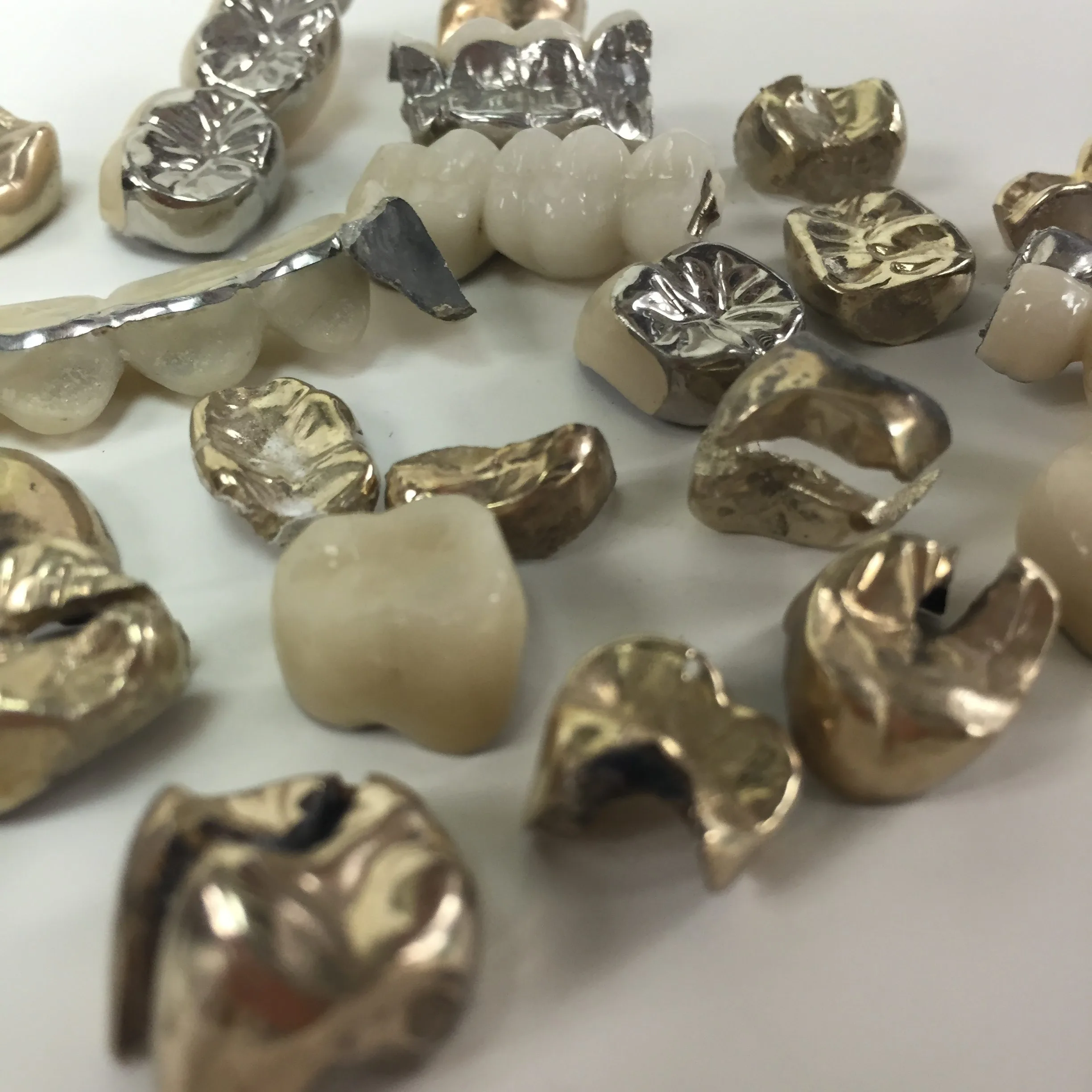
Why you cannot tell the gold content of inherited dental gold by looking
Dental crowns and bridges are cast from alloys, not pure gold. The American Dental Association's page on materials for indirect restorations sets out a 2003 classification, which it marks as archived and for information only, that sorts dental alloys into high noble, noble and predominantly base by their gold and platinum-group content. Those classes are bands defined by thresholds, not measurements of any particular crown. Two pieces of the same color can contain very different amounts of gold, and a tooth-colored surface can hide a gold alloy or a base metal underneath. For bridges, see how much gold is in a dental bridge.
Dental records naming an alloy can be worth keeping, but they describe a product, not the metal in the piece in front of you. Please do not file, scratch or acid-test a relative's dental work: home tests damage the piece and still do not give you a percentage. How to identify dental gold covers the safe visual signs. Pieces you are unsure about can be sent; offers are based on gold content, and base metal pieces add no gold.
Who can sell inherited dental gold?
Dental Gold Experts buys from sellers who own the material or are authorized to sell it. With inherited dental gold, working out whether that describes you is an easy step to overlook, and the answer depends on where your relative lived, whether there is a will, and how the estate is being handled. This guide does not give legal advice and cannot answer the question for your family, but it can explain who usually decides.
Three separate questions are easy to run together: who owns the pieces, who has legal authority to act for the estate, and whether the family agrees with a sale. Agreement among relatives is worth having, but it does not by itself establish who has legal authority to sell estate property.
When someone dies, the person in charge of their property is often called the personal representative. The IRS guide for survivors, executors and administrators describes a personal representative as "an executor, administrator, or anyone who is in charge of the decedent's property", and says their primary duties are to "collect all the decedent's assets, pay the decedent's creditors, and distribute the remaining assets to the heirs or other beneficiaries." Small items such as old dental gold can be part of that property.
How that works varies by state. California's court self-help pages on probate note that, depending on the amount and type of property, "you may or may not need to go to court to transfer or inherit the property." In Texas, the legal-aid guide to small estate affidavits describes a simpler route that is available only in limited circumstances, such as when the person left no will, and that must be signed by all heirs or by someone with legal authority on their behalf. Other states have their own procedures.
Before you sell a relative's dental gold, these questions usually settle it:
- Has an executor or administrator been appointed? If so, that person generally has authority to deal with the estate's property, including small items, so ask them whether the pieces may be sold and by whom.
- Is the estate still being settled? If it is, wait until whoever is handling it confirms who may sell. There is no reason to rush.
- Do other relatives share in the estate? California's self-help guidance says that "relatives should generally talk to each other to decide who and how decisions will be made for the estate." Agreeing first helps avoid disputes later, but agreement is not the same as legal authority to sell.
- Still unsure? Ask the executor, or a lawyer who handles estate or probate matters in the state where your relative lived.
Selling inherited property can also have tax consequences. The IRS page on gifts and inheritances explains that your basis in inherited property is generally its fair market value on the date of death, that you have a taxable gain only if you sell for more than your basis, and that the proceeds of a sale count when deciding whether you need to file a return. Whether a particular sale produces a gain or a filing requirement depends on your circumstances; a tax professional can tell you how this applies to you.
If dental work is still in place
This guide covers inherited dental gold that was removed during your relative's lifetime and is already in the family's possession. It does not cover dental work that is still in place, and it does not suggest that families can claim or retrieve restorations from a person's remains. Those questions are governed by state law and funeral practice, and the rules differ: Utah, for example, makes it a misdemeanor to remove dental gold from human remains without the specific written permission of the person who has the right to control those remains.
If you have questions about dental work before a burial or cremation, the right person to ask is the funeral director handling the arrangements. A dental gold buyer is not the right source for that advice.
Keeping it, selling it, or keeping part of it
Inherited dental gold is not only metal. For some families, a parent's or grandparent's crown is a small but real connection to them, and keeping it is a perfectly good decision. For others, it is simply one more thing to deal with while clearing a home, and having its gold content measured and paid for is the practical choice. Neither is wrong.
- Keep it if it has meaning for anyone in the family, if relatives have not agreed, or if you want time. Store it sealed and labeled.
- Sell it if you are authorized, nobody wants it, and you would rather know what it contains and be paid for its gold content.
- Split it if one piece matters and the rest does not. You can keep a single crown and send everything else.
Melting is irreversible, so if anyone in the family might want a piece later, set it aside before anything is sent. Our guide to what to do with old gold crowns compares keeping, selling and recycling in more detail.
What affects the value of inherited dental gold
The value of a relative's dental gold depends on how much gold it actually contains, and that cannot be known from the outside. These are the factors that decide it:
- The alloy. Dental alloys range from high-gold formulations to alloys with little or no gold.
- The amount of metal. A large bridge contains more metal than a single crown, but a small high-gold piece and a larger lower-gold piece can hold similar amounts of gold.
- Non-metal material. Porcelain, acrylic, cement and tooth structure add no gold. Payout calculations use the post-melt weight.
- The gold spot price shown in your written report. Gold prices change, so the same metal is worth different amounts at different times.
- The payout rate. Your offer is calculated from the post-melt weight, the gold percentage, the gold spot price shown in your written report, and the payout rate.
This guide does not publish typical gold percentages, weights or dollar figures for inherited dental gold, because none of them can be verified for the pieces you have. A single crown can still be evaluated; there is no minimum quantity. For the arithmetic behind an offer, see how to sell gold crowns, and if you are wondering whether a small amount is worth the trouble, is dental gold worth selling? answers it directly.
Authorized to Sell? Have the Gold Content Measured
Request your free prepaid, insured USPS shipping label. Your material is melted, the melted material is analyzed by XRF, and your written report shows the gold content your offer is based on.
How Dental Gold Experts evaluates inherited dental gold
Inherited dental gold goes through the same evaluation as any other dental gold, in this order:
- You request a free prepaid, insured USPS shipping label.
- Your prepaid USPS package is received, and Blake sorts the material.
- Everything you submit is melted together as one lot, and non-metal material is removed as part of the melting process.
- Blake analyzes multiple spots on the melted material by XRF to determine its gold content.
- You receive a written report showing the weight, the gold percentage, the gold spot price used, the payout rate and the payout calculation.
- You receive an offer based on the gold content shown in your report. If you accept, payment is issued within 24 hours, usually immediately, by Zelle, PayPal, check or ACH bank transfer.
Because everything is melted together, the report describes the lot as a whole, not each of your relative's pieces separately. If you are handling an estate, keep the written report: it records the weight, the gold percentage, the gold spot price used, the payout rate and the payout calculation for the lot. Material is usually processed the day your package arrives or the next day; packages received on a weekend are processed the next business day. The full detail is in the dental gold assay process.
If you are going through a relative's dental work, leave it exactly as it is. Porcelain, cement and tooth material do not need to come off at home. I sort the material, and non-metal material is removed as part of the melting process. And if one piece means more to you than its gold, keep it. You can send the rest.
How to send inherited dental gold if you are authorized to sell it
- Confirm you own it or are authorized to sell it. If an executor or administrator is handling the estate, check with them first.
- Set aside anything the family wants to keep. Melting is irreversible.
- Leave everything as it is. Do not clean, cut, file or separate porcelain, acrylic or tooth material. If a crown is still on an extracted tooth, contact Dental Gold Experts before you ship it.
- Keep a simple record if practical. A list of the pieces, a photo and a weight are recommended preparation; Dental Gold Experts does not require them before you ship.
- Request your label. Use the contact form; in your message, it helps to say what you have, for example "a relative's old crowns and a partial denture."
- Follow the packing instructions emailed with your label. Use a USPS Small Flat Rate Box, available free at the post office, securely tape the outside edges, attach the prepaid label and drop it at any USPS location. We provide prepaid, insured USPS shipping. For larger shipments, contact us before shipping to arrange additional coverage.
Get your free USPS shipping label
Request your label and we email a free prepaid, insured USPS shipping label and packing instructions, usually the same business day. Use a USPS Small Flat Rate Box, securely tape the outside edges, attach the label, and drop the box at any USPS location.
Melt, XRF, and written report
Blake melts your material and analyzes multiple spots on the melted material by XRF. Your written report shows the weight, gold percentage, the gold spot price used, the payout rate, and the payout calculation.
Accept and get paid
If you accept, we issue payment within 24 hours, usually immediately, by Zelle, PayPal, check, or ACH bank transfer. Receipt depends on the payment method.
The prepaid USPS shipping label and the assay are free · No minimum quantity
Get Your Shipping Label →Dental Gold Experts is based in Houston, Texas, and buys from anywhere in the country by mail; pickup is available in Houston, San Antonio, and Central Texas. Whatever your family decides about a relative's dental gold, the decision can wait until everyone is ready.
Authorized to Sell a Relative's Dental Gold? Start Here
Request your free prepaid, insured USPS shipping label. Everything you submit is melted together as one lot, Blake analyzes multiple spots on the melted material by XRF to determine its gold content, and your written report shows the weight, the gold percentage, the gold spot price used, the payout rate and the payout calculation. There is no minimum quantity; a single crown is welcome.
Get Your Shipping Label →Frequently Asked Questions
Yes, if you own them or are authorized to sell them. Dental Gold Experts buys from sellers who own the material or are authorized to sell it. With inherited dental gold, that usually means confirming who has authority to act for the estate, often an executor or administrator, before anything is sent. Agreement among relatives is helpful, but it does not by itself establish that authority. The rules differ by state; if you are unsure, ask the executor or an estate or probate lawyer.
They may be, but it depends on how much gold they actually contain, and that cannot be judged by eye. Dental alloys range from high-gold formulations to alloys with little or no gold, and porcelain, cement and tooth material add no gold. Dental Gold Experts determines the gold content after melting the submitted lot, and the offer is based on that measured gold content. There is no minimum quantity; a single crown is welcome.
Dental records or an alloy name can give a preliminary idea, and you can put your own estimates into the dental gold value calculator, but neither establishes the gold content of the pieces you actually have. For its final offer, Dental Gold Experts determines the gold content by melting everything you submit together as one lot and analyzing multiple spots on the melted material by XRF. Your written report shows the weight, the gold percentage, the gold spot price used, the payout rate and the payout calculation.
No. Leave inherited dental gold exactly as it is. Porcelain, cement and tooth material do not need to come off at home, and trying to separate them can damage the metal or injure you. Blake sorts the material, and non-metal material is removed as part of the melting process. If a crown is still on an extracted tooth, contact Dental Gold Experts before you ship it.
Yes, as metal. Dental gold is melted, assayed and refined so that the gold can be used again; the crown itself is not reused. For a family, selling to a dental gold buyer is one way that recycling begins. If anyone wants to keep a piece, set it aside first, because melting is irreversible.
Then wait. Nothing about the metal changes while it sits in a drawer, and it is best not to sell until it is clear who has authority over the estate and the family has talked it through. Keeping one piece and selling the rest is often a simple compromise. If the disagreement is about who owns or may sell estate property, the executor or an estate or probate lawyer is the right person to ask.
Verified Customer Reviews
Read what dental practices say about working with dental gold buyers they trust on Trustpilot.
Founded by Blake Plummer, a precious metals professional with 15+ years of experience buying, valuing, and refining gold.
Houston, Texas Based · Serving Dental Practices Nationwide
View Reviews on Trustpilot