Who Buys Gold Teeth Near Me?
Five kinds of buyer will take gold teeth, and they do not value them the same way. Here is what each one actually does, the questions worth asking before you hand anything over, and how to sell gold teeth by mail if there is nobody useful near you.
Free prepaid, insured USPS shipping label and packing instructions, usually emailed the same business day.
Five kinds of buyer will take them: dental gold specialists, pawn shops, coin and precious metal dealers, local jewelers, and online mail-in buyers. They do not evaluate the metal the same way, so where you sell gold teeth changes what you are offered. Dental alloys carry no karat stamp, so the thing that separates a considered offer from a guess is whether the buyer melts and assays the metal and shows you the result in writing.
- Dental Gold Experts is based in Houston, Texas and buys from customers throughout the United States by mail. Pickup is available in Houston, San Antonio, and Central Texas.
- The prepaid USPS shipping label and the assay are free, and there is no minimum quantity — a single crown is welcome, so you can sell gold teeth one piece at a time.
- You do not have to prepare anything to sell gold teeth: send the pieces as they are, with no cleaning, prying or sorting on your part.
- Offers and payment are based on gold content only, determined by melt and assay.
Before you sell gold teeth to anyone, it helps to know roughly what you are holding. The dental gold value calculator lets you try your own weight and purity figures. The final offer is determined after melting and assay.
Where to sell gold teeth: the five kinds of buyer
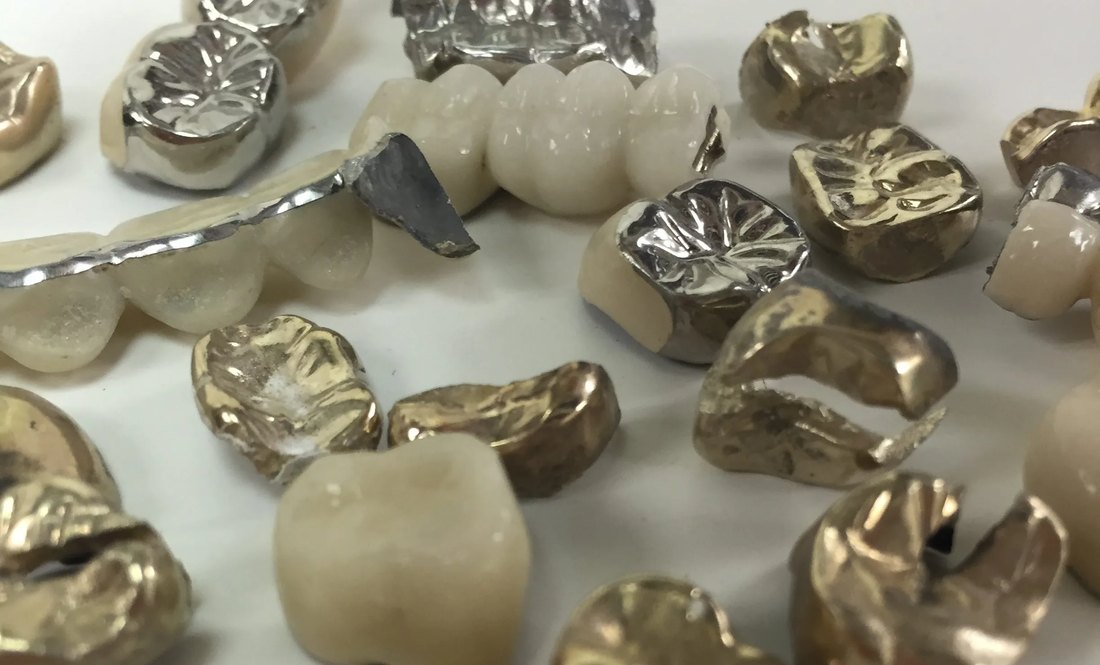
“Gold teeth” usually means one of a few things: a gold crown that came out or was extracted, a gold inlay or onlay, a bridge unit, or a small collection that has been sitting in a drawer since a relative’s dental work was returned to them. Whatever the shape, you are holding cast dental alloy, and all five of the buyers below will take it. What changes between them is how the metal gets valued, and that is the whole of the decision when you sell gold teeth.
One fact sits underneath the whole comparison: dental restorations are made from a wide range of alloys, and the profession classifies them by metal content rather than by appearance. The American Dental Association’s overview of materials for indirect restorations sets out the high-noble, noble and predominantly base-metal classes. Nothing on the piece itself tells you which class it belongs to, which is why the method a buyer uses to find out is the one thing worth asking about before you sell gold teeth to them.
1. Specialized dental gold buyers
A dental gold specialist works with this material daily and prices it the way refiners do: the pieces are melted, the melted metal is assayed, and the offer follows the gold content. This is the only one of the five places to sell gold teeth that is built specifically around dental alloys rather than around jewelry or coins. It is also usually a mail-in service, because there is no reason for a specialist to keep a shop on your high street.
2. Pawn shops
If you want to sell gold teeth quickly, a pawn shop is the most findable option and often the fastest. The limitation is the evaluation. Pawn counters are set up for marked jewelry, where a karat stamp and a scratch test get you close enough. Gold teeth carry no stamp, the alloys vary widely, and a surface test on a crown tells you about the surface.
3. Coin and precious metal dealers
Coin and bullion dealers understand metal content and spot pricing, which puts them ahead of a general second-hand buyer. Dental scrap is still a side line for most of them, and some will pass it to a refiner and keep a margin for the handling. That is a legitimate business; it just means that if you sell gold teeth this way you are a step further from the assay that decides the value.
4. Local jewelers
Some jewelers buy scrap gold over the counter. The same stamp-and-scratch limitation applies, and a jeweler’s interest is in metal they can re-use, which dental alloy generally is not. If you sell gold teeth to a jeweler, expect a conservative offer based on an estimate rather than an assay.
5. Online and mail-in dental gold buyers
Mail-in buyers cover the whole country, which matters if you want to sell gold teeth and live nowhere near a specialist — demand for this material is thin outside large cities. The trade-off is that you post your material before you see an offer, so the terms around shipping, reporting and declining matter more than the headline promise.
What to ask before you sell gold teeth to anyone
These are neutral questions. They work on a pawn counter, at a jeweler’s desk or on a website, and the answers tell you more than a price quoted before anyone has weighed anything.
| Ask this | Why it matters |
|---|---|
| How will you determine the gold content? | Dental alloys carry no karat mark. An offer made without melting and assaying the metal is an estimate |
| Do I get the figures in writing before I decide? | A written report lets you check the weight, the gold percentage and the price used against the offer |
| Which gold price are you using? | Offers should reference a stated price, not an unnamed “market rate” |
| Who pays for shipping, and is it insured? | For a mail-in buyer this is the part you cannot see. Ask before you post anything |
| What happens if I decline the offer? | Find out in advance who pays return postage and insurance, and what state the material comes back in |
| Is there a minimum quantity? | Some buyers will not look at one or two pieces |
At Dental Gold Experts: the material is melted and read by XRF, you receive a written report, the offer references the gold spot price shown in that report, the prepaid USPS shipping label is insured and free, and there is no minimum quantity. If you decline, the customer pays return postage and return insurance.
What decides what your gold teeth are worth
There is no list price when you sell gold teeth. Four things decide the figure: the post-melt weight, the gold percentage of the recovered metal, the gold spot price shown in your written report, and the payout rate applied to it. Your payout is based on the gold content of the recovered metal after melting, so tooth structure, cement and porcelain contribute nothing to the gold value.
That is the whole of the valuation logic, and it is why a guide like this one cannot sensibly quote a number for a tooth. If you want to work through the metal content itself — the alloy classes, what a crown typically weighs, why colour misleads — our guide to how much gold is in a dental crown goes through it properly. For the broader question of whether it is worth the trouble to sell gold teeth at all, is dental gold worth selling? covers it.
I spent years on the other side of a pawn counter, so I know exactly what happens when somebody walks in to sell gold teeth. You get a scratch, a glance, and a number. Nobody is trying to cheat anyone — the counter simply has no way to see inside a crown. Everything a customer sends me goes into the crucible as one lot and I read multiple spots on the melted material by XRF. That is the difference, and it is the whole reason the written report exists.
White or silver-coloured teeth count too
Plenty of dental work that holds precious metal is not gold-coloured. Porcelain-fused-to-metal crowns and white alloys can contain gold alongside palladium and platinum, so a bright white crown may be worth including even though it looks like nothing. Offers and payment are based on gold content only, so the palladium or platinum in a white alloy adds nothing to the figure: a pale piece is paid on whatever gold it contains. Our guide to white dental gold explains which pieces are worth adding to the box when you sell gold teeth.
If the teeth are still attached, in a denture, or part of an estate
People sell gold teeth in some awkward combinations, and each of these has its own guide rather than a paragraph here:
- Still cemented to an extracted tooth. You do not have to get the crown off. See gold crowns on extracted teeth, and contact us before shipping one.
- Fillings, inlays and onlays. Smaller pieces, same valuation logic: sell gold fillings, inlays and onlays.
- Gold in a denture or partial. Appliances are a special case — read can you sell gold dentures? and contact us before shipping a complete appliance.
- Inherited gold teeth. You must own the material or be authorized to sell it. Extracted dental work normally belongs to the patient, so after a death it passes with the rest of the estate. Who owns extracted dental gold? goes into the question in full.
“Where can I sell gold teeth near me?”
Searching for a buyer nearby is a reasonable instinct, and for most people in the United States the honest answer is that there is no dental gold specialist within driving distance. The pieces are small, light and easy to insure, which is exactly why this trade works by post.
Dental Gold Experts is based in Houston, Texas, and serves customers nationwide by mail. Pickup is available in Houston, San Antonio, and Central Texas; we can discuss direct pickup options in those areas. We have no retail premises anywhere and no set pickup schedule. If you are in Texas, our pages for Houston, San Antonio, Austin and Dallas set out what applies where, and the dental gold buyers near me hub covers the rest. Everywhere else you can still sell gold teeth to us by mail, and the label comes to you.
Sell Gold Teeth From Any Post Office
Request your free prepaid, insured USPS shipping label and packing instructions, usually emailed the same business day. Use a USPS Small Flat Rate Box, securely tape the outside edges, attach the label, and drop it at any USPS location.
How to sell gold teeth to Dental Gold Experts
Get your free USPS shipping label
Request your label and we email a free prepaid, insured USPS shipping label and packing instructions, usually the same business day. For larger shipments, contact us before shipping to arrange additional coverage.
Melt, XRF, and a written report
We usually process your material the day your package arrives or the next day; packages received on a weekend are processed the next business day. You sign a pre-melt agreement before anything is melted. Everything you send is melted together as one lot, and Blake analyzes multiple spots on the melted material by XRF to determine its gold content. Your written report shows the weight, the gold percentage, the gold spot price used, the payout rate, and the payout calculation.
Accept and get paid
Read the report, then decide. Payment is issued within 24 hours after you accept, usually immediately, by Zelle, PayPal, check, or ACH bank transfer; receipt depends on the method. If you decline, the customer pays return postage and return insurance. The full process is set out in how to sell dental gold.
Ready to Sell Gold Teeth?
Request your free prepaid, insured USPS shipping label and packing instructions, usually emailed the same business day. Blake melts everything you send as one lot, analyzes multiple spots on the melted material by XRF, and sends you a written report with your offer. Payment is issued within 24 hours after you accept.
Get Your Shipping Label →Frequently Asked Questions
Verified Customer Reviews
Read what dental practices say about working with dental gold buyers they trust on Trustpilot.
Founded by Blake Plummer, a precious metals professional with 15+ years of experience buying, valuing, and refining gold.
Houston, Texas Based · Serving Dental Practices Nationwide
View Reviews on Trustpilot