What Are Gold Crowns Made Of? Alloys, Dental Records and Measured Gold Content
What are gold crowns made of? Dental alloys, not pure gold. This guide explains which metals go into those alloys, what high noble, noble and predominantly base mean, how to find the alloy your dentist used, and why only melting and testing measures the gold in the crown you actually have.
Free prepaid, insured USPS shipping label and packing instructions, usually emailed the same business day.
Gold crowns are made of dental alloys, not pure gold. Gold is too soft on its own, so it is alloyed with other metals such as copper, silver, platinum and palladium. How much gold a crown contains depends on the alloy the lab used, and that varies widely: some gold-colored alloys are mostly gold, others contain very little. Your dentist's records may name the alloy or its class, but only melting and testing measures the gold in the crown you actually have.
- Dental alloys are classed by their noble-metal content: high noble, noble or predominantly base.
- Only the high noble class sets a gold minimum, and it is a floor, not a typical figure.
- Color, shine and weight cannot tell you the gold percentage.
- Records, insurance codes and alloy certificates describe the alloy as sold, not your melted metal.
- Offers from Dental Gold Experts are based on the gold content shown in a written report.
Want a rough idea first? Put your own estimates into the dental gold value calculator. The final offer is determined after melting and assay.
What are gold crowns made of, and why not pure gold?
A "gold crown" is a crown cast from a gold-containing dental alloy. The American Dental Association's page on materials for indirect restorations explains why: because gold is so soft and malleable, it must be hardened with copper, silver, platinum or another hard, durable metal. The same page gives an example of how much difference that makes: adding 10% copper by weight raises gold's tensile strength from 104 MPa to 395 MPa.
So the honest answer to "What are gold crowns made of?" is gold plus whatever the alloy's maker added to it. The alloy was chosen from a manufacturer's range when your crown was made, and manufacturers publish very different recipes, from alloys that are mostly gold to alloys that contain only a few percent.
The metals in a dental gold alloy and what each one does
The question "What are gold crowns made of?" is really about what else is in the alloy. Most of the other metals are there to make the crown strong and castable and, for porcelain-covered crowns, able to bond to porcelain. The ADA page names these ingredients and their jobs:
| Metal | Why it is in a dental alloy |
|---|---|
| Gold | The main noble metal in gold alloys; stable and inert in the mouth, but too soft to use alone |
| Copper, silver, platinum | Harden and strengthen the gold |
| Palladium | A platinum-group metal; its low thermal expansion makes it a common ingredient in alloys for porcelain-fused-to-metal crowns |
| Indium, tin, iron | Added to high noble and noble alloys to improve bonding with porcelain |
| Rhenium, ruthenium | Rhenium improves granularity and ruthenium castability |
| Gallium | Appears in some high noble and noble alloys made for porcelain-fused-to-metal crowns |
Source: ADA, Materials for indirect restorations. Not every alloy contains every metal, and the proportions differ from one alloy to the next.
Base-metal alloys are a different family. The ADA page names nickel-chromium and cobalt-chromium as the most common base alloys, and it treats them separately from the noble alloys. Titanium is classed on its own.
How dental alloys are classified: high noble, noble and predominantly base
Part of the answer to "What are gold crowns made of?" is a label rather than a recipe. Dentists, labs and insurers often describe a crown's metal by its class, not its gold percentage. The ADA's materials page presents them as the ADA Council on Scientific Affairs' 2003 classification by noble-metal content and marks that table as archived and for information only. The same thresholds appear in the CDT Code's classification of materials, which the code includes to help dentists choose the right procedure code, and the class names appear in the crown codes on dental claims (more on that below).
In this system, "noble metals" means gold and the platinum-group metals: platinum, palladium, iridium, rhodium, osmium and ruthenium. Silver is not on that list, so it does not count toward the noble total.
| ADA class (2003) | The rule | What it says about gold |
|---|---|---|
| High noble | Gold and platinum-group metals at least 60%, and gold at least 40% | The only class with a gold minimum. 40% is a floor, not a typical figure |
| Noble | Gold and platinum-group metals at least 25% | No separate gold requirement. The noble share can be mostly palladium, with little gold |
| Predominantly base | Gold and platinum-group metals less than 25% | A ceiling, not a minimum. The alloy may contain no gold at all |
| Titanium and titanium alloys | Titanium at least 85% | Not a gold alloy |
Source: ADA Council on Scientific Affairs (2003), as reproduced on the ADA's Materials for indirect restorations page, where it is marked archived and for informational purposes only.
Two things often get mixed up with these classes:
- Karat is a different measure. Karat expresses gold content in twenty-fourths. A class tells you which band of noble-metal content an alloy falls into, not its karat. For the conversion, see what karat is dental gold.
- "Type" numbers describe strength, not gold. Under ANSI/ADA Standard No. 134 / ISO 22674, metallic dental materials are sorted into Types 0 to 5 by their intended use, yield strength and elongation, as the ADA page's Table 3 shows. A Type 4 alloy can be mostly gold or mostly palladium.
Examples of published alloy compositions
The most concrete answer to "What are gold crowns made of?" comes from the manufacturers, who publish the composition and ADA class of the alloys they sell. These examples show how wide the spread is, and why neither color nor class settles the gold content. They are examples of manufacturer specifications for alloys as sold, not typical crown compositions or measurements of any submitted crown.
| Alloy (manufacturer) | Described as | ADA class stated | Gold stated |
|---|---|---|---|
| Aquarius XH (Ivoclar) | Rich yellow, for porcelain-fused-to-metal work | High noble | 82.8% |
| DPM Argenco 75 (Argen) | Very rich yellow, full cast (digital-workflow product) | High noble | 75.5% |
| W (Ivoclar) | White, for porcelain-fused-to-metal work | High noble | 54.0% |
| Capricorn (Ivoclar) | White, palladium-based, for porcelain-fused-to-metal work | Noble | 6.0% |
| ArgenMill Au2 (Argen) | Warm yellow, sold for milled crowns | Noble | 2% |
Figures as published on each manufacturer's product page, read October 19, 2026. Argen lists only the main metals, so its figures do not add up to 100%. Aquarius XH and Capricorn are listed on Ivoclar's Canadian site but no longer have a US product page. These are current products; older crowns may have been made from alloys that are no longer sold. A yellow alloy can contain 2% gold and a white one more than half gold.
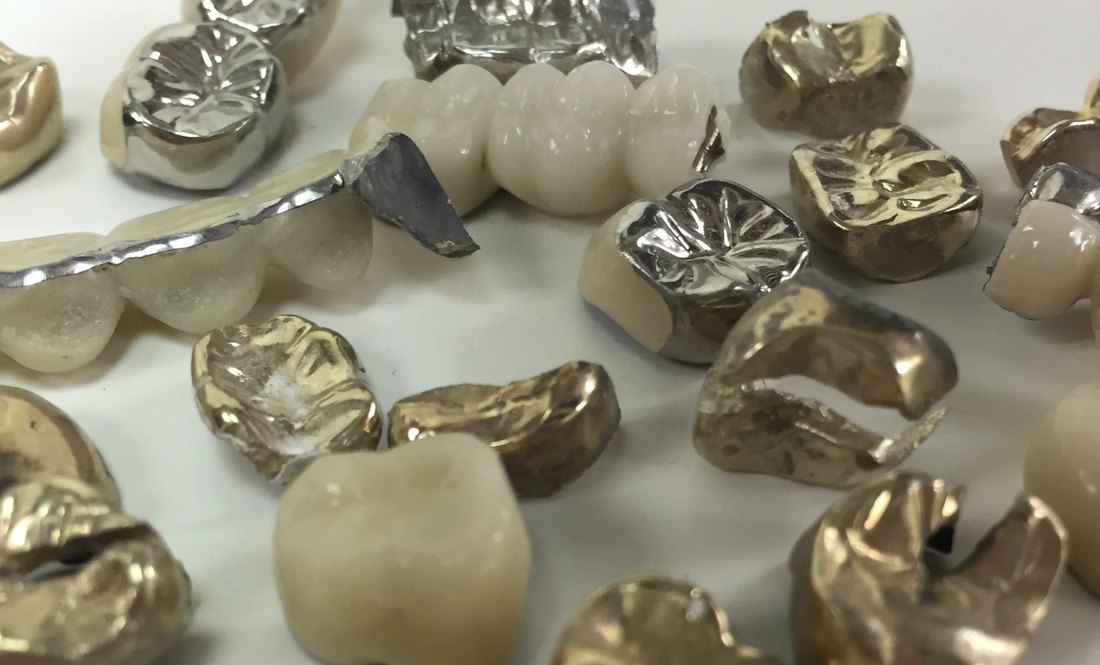
Gold-colored, white and porcelain-fused-to-metal crowns compared
When people ask what their crown is made of, they are usually holding one of these. This is what can and cannot be inferred from the kind of restoration alone.
| Restoration | What it is made of | What you can infer | What you cannot tell |
|---|---|---|---|
| Gold-colored all-metal crown | One piece of cast alloy | It is a cast dental alloy; color alone does not show whether it contains gold | The class or gold percentage; warm-yellow noble alloys and gold-colored alloys with no gold exist |
| White or silver-colored all-metal crown | One piece of cast alloy | It is metal | Whether it is a white high noble gold alloy, a palladium-based noble alloy or a base metal |
| Porcelain-fused-to-metal (PFM) crown | A metal alloy core with porcelain fused over it | There is metal underneath the porcelain | Which alloy the core is; claim codes exist for high noble, noble and predominantly base cores |
| All-ceramic or zirconia crown | Ceramic throughout | No metal alloy core to evaluate | — |
| Titanium crown | Titanium or a titanium alloy | Not a gold alloy | — |
Porcelain, cement and tooth structure add no gold to any of them.
For white alloys in more depth, see white dental gold; for bridges, which combine several units, see how to sell dental bridges.
Why color, shine and weight cannot give you a gold percentage
The examples above already show it: color follows the whole recipe, not the gold alone. In a 2024 forensic case report, "All that glitters is not gold", a gold-colored dental prosthesis that had first been classified as a gold-palladium alloy was analyzed by X-ray fluorescence; no gold or palladium was detected, and the authors concluded it was most probably a copper-aluminum alloy.
Weight in the hand is no better. A porcelain-covered crown carries non-metal material, a thick base-metal crown can feel substantial, and a small high-gold crown can feel light. Physical clues still help you decide whether a piece is worth sending, and how to identify dental gold covers them, but none of them produces a gold percentage.
How to find out what your crown was made of: the paperwork route
The general answer to "What are gold crowns made of?" is "an alloy." The specific answer for your crown may be on paper, if the records still exist: in your dental records, in the billing for the crown, or on an alloy certificate. These are the places to look.
1. Ask your dentist's office for a copy of your records
The U.S. Department of Health and Human Services explains that the HIPAA Privacy Rule gives you, with few exceptions, the right to inspect, review and receive a copy of your medical records and billing records held by covered health care providers. HHS lists dentists among the providers this covers, as long as the practice conducts certain standard transactions electronically. Ask for the treatment notes and the billing for the crown, and mention the tooth and the approximate date if you know them.
The right covers the records the office actually has. It does not guarantee that an alloy name, a lab slip or a certificate was ever recorded or kept, and records for very old crowns, or from a practice that has closed, may no longer be available. The office may charge a reasonable fee for copying and mailing. This is general information, not legal advice.
2. Ask which procedure code was billed
Dental procedures are reported to insurers using the ADA's Code on Dental Procedures and Nomenclature (the CDT Code), which federal HIPAA rules adopt as the code set for dental services. If the crown was billed to dental insurance, ask the office which code was used for it. Several crown codes name the alloy class directly. These descriptors are from the Maryland Medicaid fee schedule, which states that its nomenclature is taken verbatim from CDT 2026:
| Code | Descriptor | What it tells you |
|---|---|---|
| D2790 | Crown – Full Cast High Noble Metal | All-metal crown billed as high noble |
| D2792 | Crown – Full Cast Noble Metal | All-metal crown billed as noble |
| D2791 | Crown – Full Cast Predominantly Base Metal | All-metal crown billed as predominantly base |
| D2750 | Crown – Porcelain Fused to High Noble Metal | PFM crown with a high noble core |
| D2752 | Crown – Porcelain Fused to Noble Metal | PFM crown with a noble core |
| D2751 | Crown – Porcelain Fused to Predominantly Base Metal | PFM crown with a predominantly base core |
| D2794 | Crown – Titanium | Titanium crown |
A code records the material class that was billed. It names neither the exact alloy nor a measured gold content.
3. Check the chart for an alloy certificate
Alloy manufacturers can take part in the voluntary IdentAlloy program, which began in 1986. According to the IdentAlloy Council, participating manufacturers supply certificates with their materials attesting to the material's source, brand and composition and identifying its ADA category (high noble, noble or predominantly base). Each certificate has two parts: the lab keeps one in its case records and sends the other with the case to the dentist for filing in the patient's record. Not every alloy is in the program, and not every chart has kept its certificate. If yours has one, it identifies the alloy by brand and class.
4. Ask whether the lab supplied a material content notice
Some states require dental labs to disclose what a restoration is made of. Minnesota, for example, requires a registered dental laboratory to give the dentist a material content notice for each dental prosthetic appliance, requires the dentist to put it in the patient's record, and requires the dentist to provide the material content information to the patient on request (Minn. Stat. § 150A.27).
Washington's 2019 law requires a registered dental laboratory to give the prescribing dentist the manufacturer and brand name, or the FDA registration number, of the patient-contact materials in a restoration, so that the dentist may include them in the patient's record. Rules differ from state to state, so treat these as examples, not a national requirement.
5. Look up the alloy name
If you find an alloy name, the manufacturer's product page or data sheet may list its composition and ADA class, as in the examples above.
What each document can and cannot tell you
| What you find | What it tells you | What it does not tell you |
|---|---|---|
| A CDT code on a claim or bill | The class billed for that crown | The alloy name or its gold percentage |
| An alloy name in the chart or on a lab slip | The product recorded for that crown, and through the data sheet its published composition | The measured gold content of the metal you hold |
| An IdentAlloy certificate | Brand, manufacturer, composition and class of the alloy as supplied | The measured gold content of the metal you hold |
| Nothing at all | Nothing about the alloy | It does not mean the crown has no gold |
An alloy specification is not a measured assay of your crown
A data sheet answers "What are gold crowns made of?" only in general. Even a perfect record describes an alloy as it was sold, not the crown you are holding today. There are good reasons the two can differ:
- Matching the record to the piece. A record belongs to a tooth and a date. Removed crowns usually come without labels, and a bag of old dental work can hold pieces from different years, dentists and labs.
- Non-metal material. Porcelain, cement and sometimes tooth structure come with the metal, and none of it contains gold.
- Multi-part work. A bridge or a set of crowns may not all be one alloy.
- A specification is nominal. A data sheet gives the composition of the product as manufactured; it is not a measurement of a particular casting.
Paperwork helps you understand what you have, but an offer from Dental Gold Experts is based on the gold content measured after melting.
Have the Gold Content Measured, Not Guessed
Request your free prepaid, insured USPS shipping label. Your material is melted, the melted material is analyzed by XRF, and your written report shows the gold content your offer is based on.
How Dental Gold Experts measures the gold content
For a seller, the practical version of "What are gold crowns made of?" is how much gold your metal actually contains. An offer from Dental Gold Experts is not based on a crown's color, class or paperwork. The evaluation runs in this order:
- You request a free prepaid, insured USPS shipping label.
- Your prepaid USPS package is received, and Blake sorts the material.
- Everything you submit is melted together as one lot, and non-metal material is removed as part of the melting process.
- Blake analyzes multiple spots on the melted material by XRF to determine its gold content.
- You receive a written report showing the weight, the gold percentage, the gold spot price used, the payout rate and the payout calculation.
- You receive an offer based on the gold content shown in your report. If you accept, payment is issued within 24 hours, usually immediately, by Zelle, PayPal, check or ACH bank transfer.
Your offer is calculated from the post-melt weight, the gold percentage, the gold spot price shown in your written report, and the payout rate. Because everything is melted together, the report describes the lot as a whole, not each crown separately. Material is usually processed the day your package arrives or the next day; packages received on a weekend are processed the next business day. The full detail is in the dental gold assay process.
Keep whatever paperwork you have; it is a good way to understand what you are holding. But leave the crowns as they are. I sort the material, and non-metal material is removed as part of the melting process. The gold percentage on your report comes from the melted metal, not from a label, a code or a color.
If you have a removed crown and want to know its gold value
- Leave it as it is. Do not clean, cut, file or try to separate porcelain or tooth material. If a crown is still on an extracted tooth, contact Dental Gold Experts before you ship it; see gold crowns on extracted teeth.
- Set aside anything you want to keep. Melting is irreversible. If you are still deciding, what to do with old gold crowns compares keeping, selling and recycling.
- Keep any records with your own notes. An alloy name or class helps you set expectations. A list, a photo and a weight are recommended preparation if practical; Dental Gold Experts does not require them before you ship.
- Get a rough estimate if you like. The dental gold value calculator estimates from the gold spot price and the gold purity you enter.
- Request your label and pack the crown. Use a USPS Small Flat Rate Box, available free at the post office, securely tape the outside edges, attach the prepaid label and drop it at any USPS location. We provide prepaid, insured USPS shipping. For larger shipments, contact us before shipping to arrange additional coverage.
There is no minimum quantity; a single crown is welcome. For the selling side in more detail, see how to sell gold crowns.
If the crown is still in your mouth
Dental Gold Experts can evaluate a crown only after it has been removed, because its gold content is measured after melting. If you are curious what your crown is made of, ask your dentist: the office may be able to tell you the alloy or its class from your chart, and you can ask for a copy of the records described above. Never try to remove a crown yourself.
If a crown is going to be replaced, you can ask your dentist ahead of time what will happen to the old one.
Get your free USPS shipping label
Request your label and we email a free prepaid, insured USPS shipping label and packing instructions, usually the same business day. Use a USPS Small Flat Rate Box, securely tape the outside edges, attach the label, and drop the box at any USPS location.
Melt, XRF, and written report
Blake melts your material and analyzes multiple spots on the melted material by XRF. Your written report shows the weight, gold percentage, the gold spot price used, the payout rate, and the payout calculation.
Accept and get paid
If you accept, we issue payment within 24 hours, usually immediately, by Zelle, PayPal, check, or ACH bank transfer. Receipt depends on the payment method.
The prepaid USPS shipping label and the assay are free · No minimum quantity
Get Your Shipping Label →Dental Gold Experts is based in Houston, Texas, and buys dental gold from anywhere in the country by mail; pickup is available in Houston, San Antonio, and Central Texas. Dental practices and labs that keep crowns and invoices together may find the dental scrap inventory log useful for recording what goes into each lot.
Have a Removed Gold Crown? Find Out What It Really Contains
Request your free prepaid, insured USPS shipping label. Everything you submit is melted together as one lot, Blake analyzes multiple spots on the melted material by XRF to determine its gold content, and your written report shows the weight, the gold percentage, the gold spot price used, the payout rate and the payout calculation. There is no minimum quantity; a single crown is welcome.
Get Your Shipping Label →Frequently Asked Questions
No. Pure gold is too soft for a crown, so dental gold crowns are cast from alloys in which gold is combined with metals such as copper, silver, platinum or palladium. The gold share depends on the alloy the lab used; manufacturers publish alloys ranging from mostly gold to only a few percent.
Commonly platinum, palladium, silver and copper, which harden the alloy, plus small amounts of metals such as indium, tin, iron, gallium, rhenium or ruthenium in alloys made for porcelain-fused-to-metal crowns. Not every alloy contains all of them, and the proportions differ from one alloy to the next.
They are alloy classes. Under the ADA's 2003 classification, now archived, high noble means gold and platinum-group metals of at least 60% with gold at least 40%; noble means gold and platinum-group metals of at least 25%, with no separate gold minimum; predominantly base means less than 25%, and may include no gold at all. Crown procedure codes such as D2790 (full cast high noble metal) use these class names.
They can tell you what was used, not what you have. A procedure code gives the class that was billed, and an alloy name or an IdentAlloy certificate points to the manufacturer's published composition. None of these is a measurement of the metal in your crown today. The gold content is measured after melting.
Some do. White high noble alloys with more than half gold exist, as do palladium-based alloys with little gold and base metals with none. A porcelain-fused-to-metal crown has a metal core that may be high noble, noble or predominantly base. An all-ceramic or zirconia crown has no metal core.
Have it melted and assayed. At Dental Gold Experts, everything you submit is melted together as one lot, and Blake analyzes multiple spots on the melted material by XRF to determine its gold content. Your written report shows the weight, the gold percentage, the gold spot price used, the payout rate and the payout calculation, and the offer is based on that gold content.
Verified Customer Reviews
Read what dental practices say about working with dental gold buyers they trust on Trustpilot.
Founded by Blake Plummer, a precious metals professional with 15+ years of experience buying, valuing, and refining gold.
Houston, Texas Based · Serving Dental Practices Nationwide
View Reviews on Trustpilot