What to Do With Old Gold Crowns: Your Options Explained
Wondering what to do with old gold crowns? You can keep them, have their gold content evaluated and sell them, or have the metal recycled. This guide compares the realistic options, explains what cannot be learned by looking at a crown, and sets out what to do before sending one anywhere.
Free prepaid, insured USPS shipping label and packing instructions, usually emailed the same business day.
If you have an old gold crown, you can keep it, have its gold content evaluated and sell it, or have the metal recycled. The right answer to what to do with old gold crowns depends on whether the crown has personal meaning, whether it actually contains recoverable gold, and what you want from it. You do not need to know its gold content before asking for an evaluation, and a gold-coloured crown does not always contain gold.
- Keeping an old crown is a reasonable decision. Selling is optional.
- What a crown is worth cannot be read from its colour, its weight in the hand, or a porcelain exterior. It is measured after melting.
- A crown that has just come loose is a dental matter first. Ask a dentist before treating it as scrap.
- Crowns with porcelain or tooth material still attached are accepted as they are. Do not try to separate anything yourself.
- Offers from Dental Gold Experts are based on the gold content measured after melting and shown in a written report.
Not sure what your old crown contains? See how the dental gold assay process measures it, or put your own estimates into the dental gold value calculator. The final offer is determined after melting and assay.
What to do with old gold crowns: the four options compared
Most people with this question have one or two removed gold crowns in a drawer, handed back by a dentist years ago, and no clear idea whether they are worth anything or where they could go. There are four realistic paths. Three are decisions you can make yourself; the fourth is a question for a dentist.
| Option | When it makes sense | What to consider |
|---|---|---|
| Keep it | Sentimental or personal reasons, a family keepsake, or simply wanting more time to decide | Store it safely and label it; its gold content stays unknown until it is measured |
| Sell it | You no longer want it and would rather have its gold content measured and paid for | Actual metal content, which cannot be judged by eye, and the buyer's process and written report |
| Recycle the metal | You want the metal recovered and put back into use rather than left in a drawer | Metal crowns are recycled by melting and refining; the usual routes are a dental-gold buyer or refiner, or a dental practice or lab that collects scrap |
| Ask a dentist about reuse | You are thinking about a dental use, such as a crown that has just come off | Clinical suitability is a professional assessment; a crown is made for one tooth |
The metal in a crown does not change by sitting in a drawer, so deciding what to do with old gold crowns does not have to be rushed. The rest of this guide takes each option in turn.
Option 1: keep your old gold crown
Keeping is the first answer to what to do with old gold crowns, and it is a legitimate one: selling is optional. People keep old dental gold for reasons that have nothing to do with metal prices: a crown that belonged to a parent or grandparent, a piece of their own dental history they are curious about, or the wish to wait until other pieces turn up and decide about all of them at once. All of those are sound reasons, and nobody at a metal buyer should talk you out of them.
If you keep it, a little practical care helps. A crown removed from a tooth may still carry cement and small amounts of tooth material, so store it in a sealed, labelled container rather than loose in a drawer, and keep it away from children. A labelled container also makes life easier later if you or a family member decide to have it evaluated, because you will know which piece came from where.
Two cautions. Keeping a crown is not a final decision, and it does not establish what the crown contains, so avoid building expectations around it. And if the real question is whether the crown belongs to you in the first place, that is a separate subject covered in who owns extracted dental gold; this guide assumes the crown is already yours.
Option 2: sell your old gold crown
Selling is the second answer to what to do with old gold crowns. An old crown may contain recoverable precious metal, but how much cannot be established from the way it looks. Dental crowns are cast from alloys, not from pure gold. The American Dental Association's materials for indirect restorations page groups these alloys as high noble, noble and predominantly base by their gold and platinum-group content. The categories are thresholds, not measurements: a high noble alloy must contain at least 40% gold, but the actual figure in a given crown can be anywhere above that. The Cleveland Clinic's overview of dental crowns lists gold, palladium, nickel and chromium among the metals technicians use, which is why two crowns of the same colour can have very different gold contents.
If value is what will decide it for you, keep five things in mind:
- Colour is not composition. Yellow alloys vary widely in gold, some white alloys contain gold, and some yellow-toned pieces contain very little.
- Non-metal material adds no gold. Porcelain, cement and tooth structure contribute nothing to the gold content of the lot.
- Weight and composition set the figure together. A small high-gold crown and a larger lower-gold piece can contain similar amounts of gold.
- A written evaluation is what you are buying. It should show the weight, the gold percentage, the gold spot price used, the payout rate and the calculation, so the offer can be checked.
- One crown is still worth evaluating. There is no minimum quantity at Dental Gold Experts; a single crown is welcome.
This guide deliberately does not publish typical crown weights, gold percentages or dollar figures, because none of them can be verified for the crown in your hand. For the full selling process, what decides the offer and a worked example, read how to sell gold crowns. If the question is whether a small amount is worth the trouble at all, is dental gold worth selling? answers it directly.
Ready to Have Your Dental Gold Evaluated?
Request your free prepaid, insured USPS shipping label. Your material is melted, the melted material is analyzed by XRF, and your written report shows the gold content your offer is based on.
Option 3: recycle the metal
Recycling is the third answer to what to do with old gold crowns, and it means recovering the metal, not reusing the crown. Five words get mixed together here, and they describe different steps:
- Selling transfers the crown to a buyer, who pays for the metal it contains. For most individuals this is how recycling starts.
- Melting turns the crown, together with any other scrap in the lot, into a single mass of metal.
- Assaying measures what that melted metal contains, above all its gold content, so that it can be valued.
- Recovering is the broad term for getting usable metal out of scrap.
- Refining separates and purifies the individual metals so they can be used again in new products.
Dental scrap is a recognised part of the recycled-gold supply. The World Jewellery Confederation's March 2025 recommended definition of recycled gold describes post-consumer recycled gold as "gold obtained by refining products sourced from individuals, organisations or industrial facilities in their role as end-users" and lists "dental scrap" among the products it includes. In plain terms: once an old crown is melted and refined, its gold goes back into circulation rather than staying in a drawer.
There is more than one route in. An individual usually sells to a dental-gold buyer or a refiner. A dental practice or laboratory that collects removed restorations sends its accumulated scrap on in bulk, the route described in our dental office scrap gold SOP, and some patients choose to leave a crown with the practice for that reason. Either way the metal ends up melted, assayed and refined. At Dental Gold Experts the steps a customer sees are the evaluation ones: your material is melted, the melted material is analyzed by XRF to determine its gold content, and you receive a written report and an offer based on that gold content. Porcelain is ceramic, not metal; it is not recoverable gold.
Can an old gold crown be reused?
This is the most common misunderstanding behind what to do with old gold crowns, so it is worth being precise. "Reuse" can mean three different things:
- Reusing the crown as a restoration. A crown is made for one prepared tooth. The Cleveland Clinic's overview describes the laboratory technician using your dentist's impressions "to create your custom dental crown". A removed crown, or one that belonged to someone else, is not a stock part that can be fitted to another tooth.
- Recycling its metal. This is possible for any metal crown and is what Option 3 describes.
- Having recovered metal used in another manufactured item. Refined metal from dental scrap re-enters the market as metal; it is not traced back to your crown, and Dental Gold Experts does not make jewelry or other items from a customer's crown. Dental alloys are not karat-graded jewelry alloys either; the jewelry-marking rules in 16 CFR § 23.3 apply to jewelry industry products, so a jeweler asked to work an unmarked dental alloy directly may reasonably decline.
A crown that has just come off is a different situation from an old crown already released for disposal. The Cleveland Clinic lists "a loose crown" among the reasons to call your dentist, and the NHS 111 Wales advice is to see a dentist and, if you have the crown, keep it safe and take it with you. Whether it can be re-cemented is the dentist's call. Only once a dentist has confirmed a crown is finished with does the question of what to do with old gold crowns arise.
How can you tell whether your old crown contains gold?
Honestly, not by looking. Before deciding what to do with old gold crowns on the strength of their appearance, be aware that the usual clues are preliminary at best:
- A yellow appearance suggests a gold-coloured alloy, but says nothing about the percentage, and a gold-toned surface can sit over a very different metal.
- A white or silver appearance does not rule gold out. Some white alloys are noble alloys containing gold; others are base metals with none. Our guide to white dental gold covers these.
- A porcelain exterior hides the metal entirely. Porcelain has been fused to metal substructures since the 1950s, according to the ADA's materials page, and the metal underneath may be a gold alloy or a base alloy.
- Weight in the hand is a weak guide. Gold alloys are dense, but a porcelain-covered crown or a thick base-metal crown can feel substantial too.
- Dental records or an alloy name can tell you the alloy as sold and are worth keeping, but they describe a product, not the measured metal in your piece. The guide to what gold crowns are made of explains where to find them.
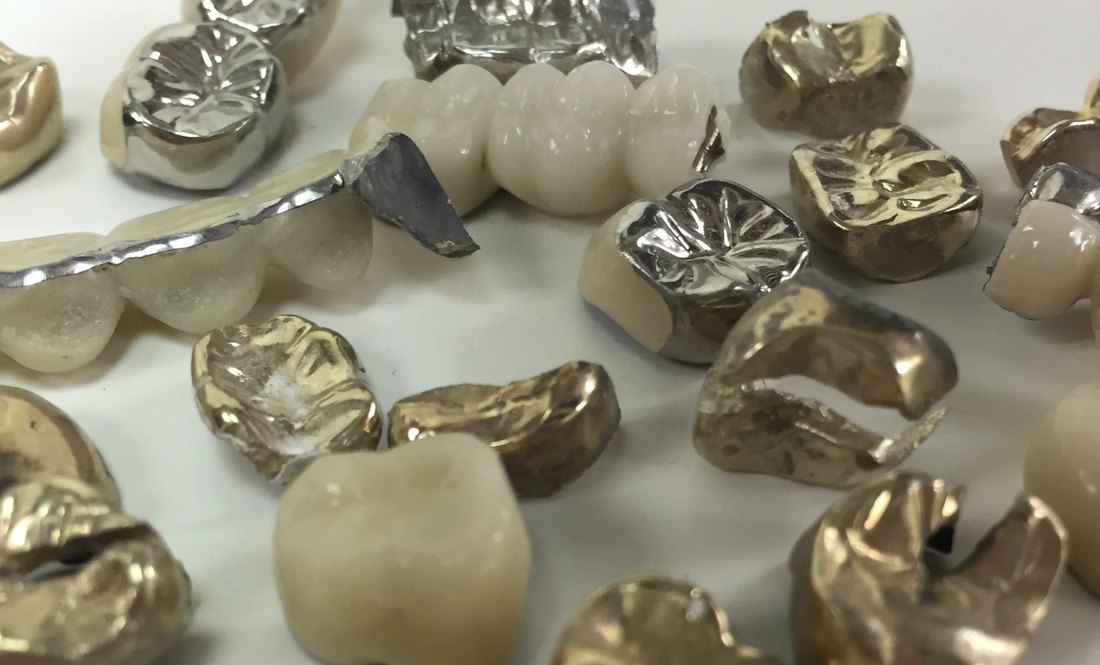
Those clues help you judge whether a piece is worth sending; they do not replace measurement. Avoid acid tests, filing, grinding or other home methods on a dental crown; they damage the piece, can remove metal, and still do not give you a percentage. How to identify dental gold goes through the safe visual signals, and what karat is dental gold explains why a crown has no karat in the jewelry sense. You do not have to be sure before you send: pieces you are unsure about are welcome, and base metal pieces add no gold.
What to do with old gold crowns that still have a tooth or porcelain attached
This question stops a surprising number of people from asking for an evaluation, so here is the plain answer: send it as it is. Dental Gold Experts accepts crowns still attached to extracted teeth, and porcelain-fused-to-metal crowns are accepted with the porcelain in place. The material is sorted, and non-metal material is removed as part of the melting process. Tooth structure, cement and porcelain contribute no gold, and payout calculations use the post-melt weight.
Do not cut, grind, burn, chemically strip or force apart dental material yourself. The non-metal parts never counted toward the gold content, so separating them gains you nothing, and rough handling can lose or damage metal or hurt you. If the crown is on an extracted tooth, contact Dental Gold Experts before you ship, because no handling or mailing instructions for teeth are published. Our guide to gold crowns on extracted teeth covers that case in full.
My advice on what to do with old gold crowns before they reach me is simple: leave them exactly as they are. Cement, porcelain and tooth material do not need to come off at home. I sort the material, and non-metal material is removed as part of the melting process. I read the melted material by XRF, so the measurement is made on the metal itself. And if you would rather keep a crown for now, keep it. The metal will be the same when you decide.
How Dental Gold Experts evaluates old gold crowns
If your answer to what to do with old gold crowns is to sell, this is the sequence, in the order it happens:
- You request a free prepaid, insured USPS shipping label, then send your eligible dental material.
- Your prepaid USPS package is received, and the material is sorted.
- Everything you submit is melted together as one lot, and non-metal material is removed as part of the melting process.
- Blake analyzes multiple spots on the melted material by XRF to determine its gold content.
- You receive a written report showing the weight, the gold percentage, the gold spot price used, the payout rate and the payout calculation.
- You receive an offer based on the gold content shown in your report. If you accept, payment is issued within 24 hours, usually immediately, by Zelle, PayPal, check or ACH bank transfer.
Two points follow. XRF readings are taken on the melted lot, not on each crown individually, so the report describes what you sent as a whole. And melting is irreversible, which is why keeping a crown you are unsure about parting with is the right call until you are sure. The step-by-step detail is in the dental gold assay process. Material is usually processed the day your package arrives or the next day; packages received on a weekend are processed the next business day.
What to do with old gold crowns before you send them
If you have decided to sell, these steps keep it simple:
- Confirm the crown is removed and that you own it or are authorized to sell it. Dental Gold Experts buys from sellers who own the material or are authorized to sell it. Never attempt to remove a crown from anyone's mouth; that is dental work.
- Leave porcelain and tooth material alone. Do not separate, clean, file or polish anything. Contact us first if a crown is on an extracted tooth.
- Gather other old dental gold at the same time if you have it. Fillings, bridges, inlays and partial-denture frameworks can go in the same lot, and everything is melted together as one lot.
- Keep a simple record if practical. A note of what you are sending, a photo and a weight are recommended preparation; Dental Gold Experts does not require them before you ship.
- Follow the packing instructions emailed with your label. Use a USPS Small Flat Rate Box, available free at the post office, securely tape the outside edges, attach the prepaid label and drop it at any USPS location. For larger shipments, contact us before shipping to arrange additional coverage.
Get your free USPS shipping label
Request your label and we email a free prepaid, insured USPS shipping label and packing instructions, usually the same business day. Use a USPS Small Flat Rate Box, securely tape the outside edges, attach the label, and drop the box at any USPS location.
Melt, XRF, and written report
Blake melts your material and analyzes multiple spots on the melted material by XRF. Your written report shows the weight, gold percentage, the gold spot price used, the payout rate, and the payout calculation.
Accept and get paid
If you accept, we issue payment within 24 hours, usually immediately, by Zelle, PayPal, check, or ACH bank transfer. Receipt depends on the payment method.
The prepaid USPS shipping label and the assay are free · No minimum quantity
Get Your Shipping Label →Dental Gold Experts is based in Houston, Texas, and buys from anywhere in the country by mail; pickup is available in Houston, San Antonio, and Central Texas. The complete route from label to payment is set out in how to sell dental gold. Whatever your answer to what to do with old gold crowns, it is yours to give, and it can wait until you are ready.
Decided What to Do With Old Gold Crowns? If It Is Selling, Start Here
Request your free prepaid, insured USPS shipping label. Everything you submit is melted together as one lot, Blake analyzes multiple spots on the melted material by XRF to determine its gold content, and your written report shows the weight, the gold percentage, the gold spot price used, the payout rate and the payout calculation. There is no minimum quantity; a single crown is welcome.
Get Your Shipping Label →Frequently Asked Questions
Either is a reasonable decision, and it is the heart of what to do with old gold crowns. Keep it if it has personal meaning or you want time to decide; nothing about an old crown forces a quick choice. Sell it if you no longer want it and would rather have its gold content measured and paid for. The one thing to avoid is deciding on appearance alone, because the gold content of a crown cannot be read from its colour or its weight in the hand.
No. That is the main reason what to do with old gold crowns cannot be decided by eye. A yellow colour suggests a gold-coloured alloy, but dental alloys range from high-gold formulations to alloys with little gold, and a gold-toned surface can sit over a very different metal underneath. The only reliable way to know is measurement after melting. You can send a crown you are unsure about; base metal pieces add no gold.
Send them as they are. Porcelain-fused-to-metal crowns are accepted with the porcelain in place. The porcelain itself contains no gold, but the metal underneath it may. Do not chip, grind or strip the porcelain off yourself; Dental Gold Experts sorts the material, and non-metal material is removed as part of the melting process.
Crowns still attached to extracted teeth are accepted. Do not try to separate the crown from the tooth, and contact Dental Gold Experts before you ship an extracted tooth, because no handling or mailing instructions for teeth are published. Our guide to gold crowns on extracted teeth explains what affects the offer and what does not.
Yes, as metal, and it is the option most people overlook. Dental scrap is melted, assayed for its gold and other metal content, and refined so that the recovered metals can be used again; trade definitions of recycled gold list dental scrap among its sources. That is recycling of the metal, not reuse of the crown. Selling an old crown to a dental-gold buyer, or leaving it with a practice that collects scrap, is how that recycling usually begins.
A dental crown is made for one specific prepared tooth, so a removed crown is not a restoration that can simply be fitted to another person. Any question about re-cementing a crown that has come off, or about using a crown clinically in any way, is one for a dentist, not a metal buyer. This guide does not give dental advice.
Verified Customer Reviews
Read what dental practices say about working with dental gold buyers they trust on Trustpilot.
Founded by Blake Plummer, a precious metals professional with 15+ years of experience buying, valuing, and refining gold.
Houston, Texas Based · Serving Dental Practices Nationwide
View Reviews on Trustpilot