What Happens to Gold Teeth When Cremated? A Guide for Families
What happens to dental gold during and after cremation, what several states require before it can be removed, and what to ask the funeral home if your family wants it kept.
Free prepaid, insured USPS shipping label and packing instructions, usually emailed the same business day.
Gold teeth are not removed automatically. In many states, dental gold can only be removed from a person's remains with specific written permission from the person who has the right to control those remains, and at least one state does not allow it at all. If nothing is arranged beforehand, the dental gold goes through the cremation, and the metal left afterward is separated from the cremated remains and is typically recycled. If your family wants a relative's dental gold kept, tell the funeral director before the cremation and put your instructions in writing.
- Pure gold melts at 1,064°C (1,947°F). Cremation usually takes place between 1,400 and 1,600°F.
- California, Illinois, Ohio, and Utah require written permission or authorization to remove dental gold; Wyoming's crematory rules prohibit it.
- The funeral director handling the arrangements is the person to ask about removal.
- Dental Gold Experts accepts dental gold from funeral homes, crematories, and families when the person who has the right to control the remains has given written permission.
If your family already has a relative's dental gold, the dental gold value calculator gives a rough estimate before you ship. The final offer is determined after melting and assay.
Families planning a cremation often ask, "What happens to gold teeth when cremated?" Some want to know whether a parent's or grandparent's gold crowns can be kept; others simply want to understand what happens. The answer depends on two things: what the family arranges before the cremation, and the rules in the state where it takes place.
This guide explains what happens to dental gold during and after cremation, what several states require before it can be removed, and what to ask the funeral home. It is general information, not legal advice. The funeral director handling the arrangements can tell you how the rules apply to your family.
What happens to gold teeth when cremated
Dental gold is not pure gold. Crowns, bridges, inlays, and onlays are cast from alloys that combine gold with other metals, and the mix varies from one piece to the next (see the American Dental Association's overview of materials for indirect restorations). That matters for what the heat does to it.
Do gold teeth melt in cremation?
Not necessarily. Pure gold melts at 1,064°C (1,947°F), according to the National Library of Medicine's PubChem database. The Cremation Association of North America (CANA) says cremation usually takes place between 1,400 and 1,600°F and that the laws on required temperatures vary by state. That range is below the melting point of pure gold.
Because dental gold is an alloy, that comparison is only a rough guide. What a crown or filling looks like afterward depends on the metals in it and on the cremation itself, so no one can say in advance whether a given piece will come out whole, misshapen, or partly melted.
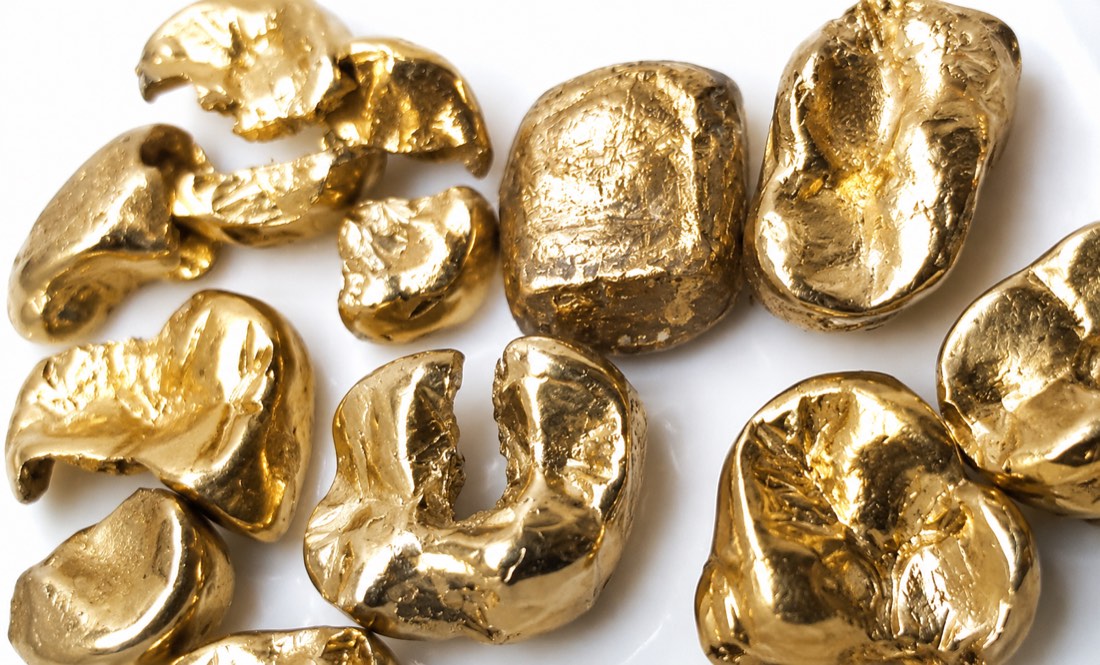
What the crematory does with metal afterward
CANA lists dental fillings among the sources of metal that can be found in cremated remains, along with surgical implants, casket handles, and jewelry that was not removed. It says the metal "is separated from the cremated remains before they are processed" and "is typically recycled."
Some dental gold can also stay behind in the equipment. California and Utah law both say that unavoidable dental gold left in the cremation chamber is not a violation of their rules on removing it.
Whether a family can ask for dental gold back depends on the state and on the instructions given before the cremation. California, for example, requires dental gold that is removed during processing to be returned with the cremated remains unless the person who has the right to control the disposition directs otherwise (California Health and Safety Code § 7051).
Are gold teeth removed before cremation?
Not automatically. Much of what happens to gold teeth when cremated is decided before the cremation, by state law and by the written permission the family gives. In the states below, removing dental gold from a person's remains needs specific written permission or authorization, and one state does not allow it at all. These are examples, not a full list, and laws change. Your funeral director can tell you what applies where the cremation takes place.
| State | What the rule says | Source |
|---|---|---|
| California | Removing or possessing dental gold from human remains without specific written permission of the person or persons with the right to control the remains is a crime. Dental gold removed during processing goes back with the cremated remains unless that person directs otherwise. | Health & Safety Code § 7051.5 and § 7051 |
| Illinois | A crematory may not remove dental gold before or after a cremation without specific written authorization from the authorizing agent and written instructions for delivering it to that person. A crematory may not profit from removing valuables. | 410 ILCS 18/35 |
| Ohio | A crematory may remove dental gold only if the cremation authorization form specifically authorizes it, and it may not charge more than its actual cost for the removal. | Ohio Revised Code 4717.26 |
| Utah | Removing or possessing dental gold from human remains without specific written permission of the person who has the right to control those remains is a misdemeanor. | Utah Code 58-9-607 |
| Wyoming | The state's crematory rules prohibit removing or possessing dental gold or dental silver from deceased persons. | Wyoming crematory rule 035-6 § 6-11 |
| Texas | A cremation requires a cremation authorization form signed by the person responsible for making arrangements for final disposition. | 22 Tex. Admin. Code § 205.11 |
Plain-language summaries of the linked texts, checked November 2026. The Wyoming and Texas rules are linked through Cornell Law School's Legal Information Institute. This table is not legal advice.
Do funeral homes remove gold teeth?
A funeral home or crematory does not decide this on its own. In the states above, removal depends on written permission from the person who has the right to control the remains (Illinois calls this person the authorizing agent), and Ohio ties it to the cremation authorization form. State law decides who that person is, so if you are not sure, ask the funeral director.
Ask early. Where removal is allowed, the permission has to be in place before the cremation, and the funeral home can tell you whether removal is possible, who would do it, and what it involves.
What happens to gold fillings during cremation?
Gold fillings, inlays, and onlays are dental gold, so they are handled the same way as gold crowns. The same state rules on removal apply, and if they are not removed beforehand they go through the cremation. They are on CANA's list of metal that can be found in cremated remains, and that metal is separated afterward and typically recycled.
Not every metal filling is gold. Dental amalgam, a mix of mercury, silver, tin, and copper, contains no gold, and Dental Gold Experts does not accept it. Our guide to selling gold fillings explains the difference.
How to ask the funeral home to keep a relative's dental gold
If your family wants a say in what happens to gold teeth when cremated, raise it with the funeral home early. These steps help you ask clearly and get an answer in writing:
- Raise it as early as you can. Where removal is allowed, permission has to be given before the cremation.
- Confirm who has the right to control the remains. That person's written permission is what the states above require. If several relatives share the decision, agree on it first.
- Ask what the state and the crematory allow. Ask whether removal is permitted where the cremation will take place, who would do it, and whether there is a charge. Ohio, for example, limits a crematory's charge to its actual cost.
- Put your instructions in writing. Include them on or with the cremation authorization form, including who should receive any dental gold and how it should be returned. Illinois requires written delivery instructions before a crematory removes anything.
- Ask about metal recovered after the cremation. Ask whether it is recycled, returned with the cremated remains, or handled another way, and whether your family can choose.
- Keep a copy of everything you sign.
If the cremation has already taken place, ask the crematory how metal was handled under the authorization that was signed. It may already have been separated for recycling, and it may not be possible to recover it.
If your family now has a relative's dental gold
Some families end up with a relative's dental gold: crowns kept from earlier dental work, or pieces returned by a funeral home or crematory under written instructions. Who may sell them depends on who owns them. After a death, that is often a question for the executor or administrator of the estate. Our guide to inherited dental gold covers who usually decides, keeping a piece as a keepsake, and selling. For dental gold a dentist removed during treatment, see who owns extracted dental gold.
Dental Gold Experts buys from sellers who own the material or are authorized to sell it. You cannot tell how much gold a piece contains by looking at it (see how to identify dental gold), so send pieces you're unsure about; your offer is based on the measured gold content. Base metal pieces add no gold. Melting is irreversible, so set aside any piece your family wants to keep before you ship.
Request your label
After you submit your request, we'll confirm your shipping address, then email your free prepaid USPS shipping label and packing instructions. Use a USPS Small Flat Rate Box and securely tape the outside edges.
Melt, XRF, and written report
Everything you submit is melted together as one lot, and Blake analyzes multiple spots on the melted material using XRF to determine its gold content. Your written report shows the post-melt weight, the gold percentage, the gold spot price used, the payout rate, and the payout calculation.
Accept and get paid
We issue payment within 24 hours after you accept our offer, usually immediately. Payment is available by Zelle, PayPal, check, or ACH bank transfer. Receipt depends on the payment method.
The prepaid USPS shipping label and assay are free · No minimum quantity
Get Your Shipping Label →If you decline our offer, your material can be returned in melted form at your expense.
For funeral directors and crematories
Dental Gold Experts accepts dental gold from funeral homes, crematories, and families when the person who has the right to control the remains has given written permission. Offers are based on the measured gold content, and the written report shows how the offer was calculated. State rules differ, so check your state's rules before removing or sending dental gold. To ask about sending dental gold, contact us.
Have a Relative's Dental Gold Measured
Request your free prepaid, insured USPS shipping label. Everything you submit is melted together as one lot, and your written report shows the gold content your offer is based on.
Get Your Shipping Label →Frequently Asked Questions
Verified Customer Reviews
Read what dental practices say about working with dental gold buyers they trust on Trustpilot.
Founded by Blake Plummer, a precious metals professional with 15+ years of experience buying, valuing, and refining gold.
Houston, Texas Based · Serving Dental Practices Nationwide
View Reviews on Trustpilot