How Much Gold Is in a Dental Crown? A Detailed Guide for Dentists in 2026
Gold content in a dental crown varies widely by alloy type, fabrication era, and crown design. This guide breaks down exactly how much gold is in a dental crown — and what that means for its scrap value today.
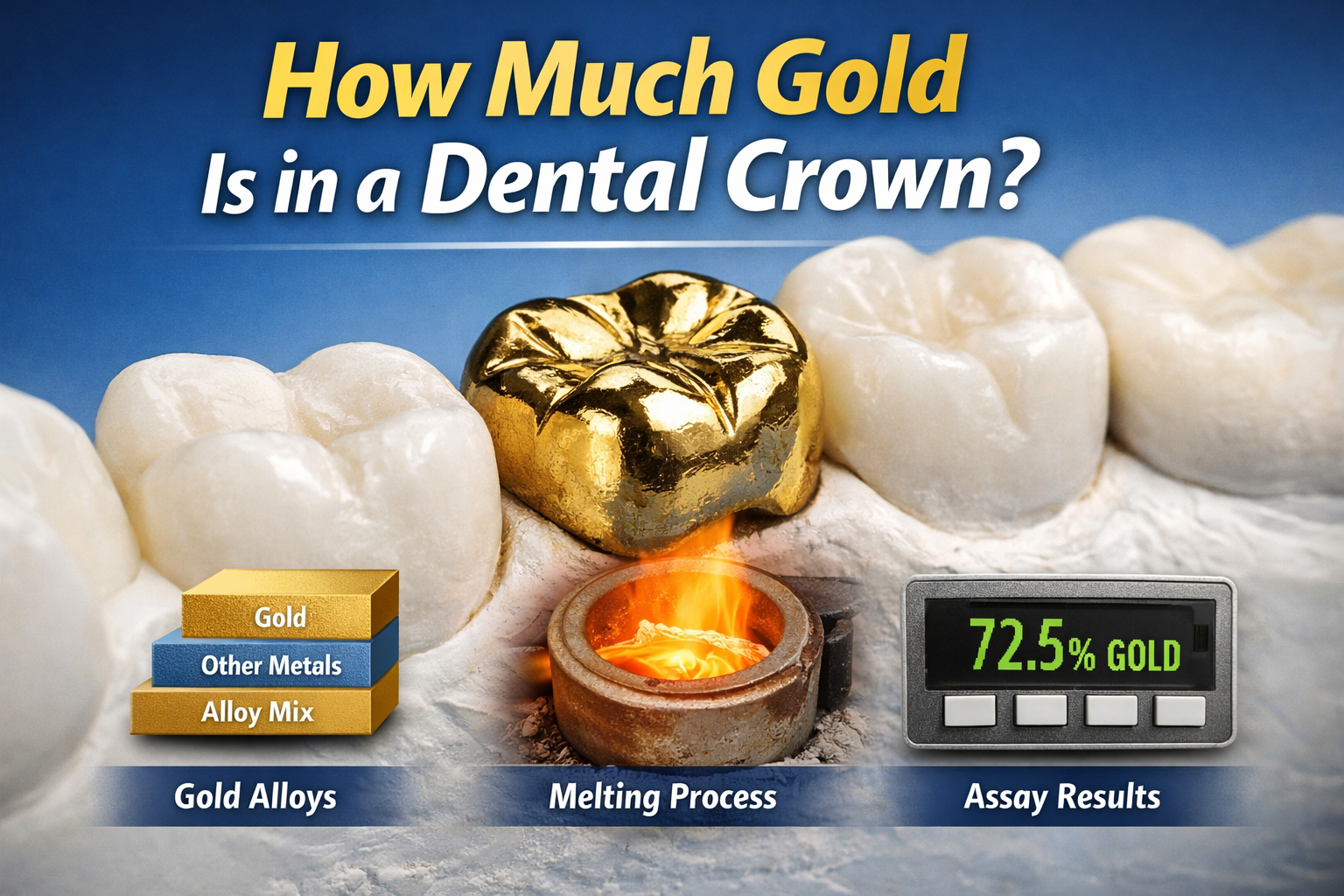
Gold crowns of different alloy types — precious metal content varies significantly depending on classification and era of fabrication
(high-noble crown)
weight range
at current spot prices
The precious metal content of a dental gold crown varies by alloy and manufacturer. A professional melt-and-assay is the only reliable way to determine the exact gold content and calculate its true value.
Dentists and patients ask how much gold is in a dental crown for two reasons: curiosity about what's been in their mouth for years, and a very practical question about what that crown is worth now that it's been removed. Both are valid. The answer isn't a single number — it depends on the alloy classification, when the crown was fabricated, and which metals the lab chose to use.
This guide breaks down gold percentage by crown type, explains the other precious metals that frequently appear alongside gold in dental alloys, and gives realistic value ranges so dentists can make informed decisions about every extracted crown that crosses their treatment chair.
How Much Gold Is in a Dental Crown: The Three Alloy Categories
The American Dental Association (ADA) classifies dental casting alloys into three categories based on precious metal content. These categories directly determine the gold percentage in any dental crown and, by extension, what it's worth as scrap.
≥60% precious metals
≥25% precious metals
<25% precious metals
How Much Gold Is in a Dental Crown by Type: Detailed Breakdown
Within the ADA's three categories, there are several distinct crown types dentists encounter regularly. Here's a detailed look at the dental alloy composition for each common type — along with weight ranges and current estimated value ranges.
| 👑 Crown Type | ⚗️ Gold Content | 🔩 Other Precious Metals | ⚖️ Typical Weight | 💰 Current Value Range* |
|---|---|---|---|---|
| Full-cast high-noble crown | 60–88% | Pt, Pd, Ag (minor) | 3–6g | $100 – $200+ |
| Full-cast noble crown (yellow) | 40–60% | Pd, Ag, Cu | 2–5g | $60 – $150 |
| Palladium-silver noble crown (white) | 0–10% | Pd 50–80%, Ag | 2–5g | $50 – $250+ |
| PFM — high-noble substructure | 50–88% | Pt, Pd | 1–3g (metal only) | $40 – $120 |
| PFM — noble substructure | 20–50% | Pd, Ag | 1–3g (metal only) | $20 – $90 |
| Gold inlay or onlay | 70–88% | Pt, Cu (minor) | 0.5–2g | $20 – $100 |
| Base metal crown | Trace or none | Ni, Co, Cr | 2–5g | Minimal |
*Value ranges based on current approximate market conditions. Actual payout depends on live spot prices and precise assay composition. Use the dental gold calculator for a quick estimate, or track current gold prices at Kitco.

The question I get asked constantly is about dental crown gold content — and the honest answer is that it depends almost entirely on what era the crown was made. Crowns fabricated before 1985 are overwhelmingly likely to be high-noble alloys with 60–88% gold. Crowns made between 1985 and 2005 often shifted toward palladium-heavy noble alloys to reduce cost as gold prices rose. Crowns made after 2005 might be anything from base metal to porcelain with no metal at all. The era of fabrication gives you a useful starting guess, but the assay gives you the real number — and that's the only one that matters.
How Much Gold Is in a Dental Crown: Why Color Is Not a Reliable Guide
One of the most persistent misconceptions about crown alloy composition is the assumption that yellow equals gold and white equals no gold. This is wrong in both directions — and acting on this assumption costs dentists and patients real money every day.
Yellow crowns do strongly suggest gold content. But a yellow appearance can also result from copper content in lower-noble or base metal alloys that contain no significant gold. Conversely, white or silver crowns frequently contain palladium — a precious metal that has, at various points in the last decade, traded above gold per troy ounce on international commodity markets. A white crown with 60–70% palladium can be worth significantly more than a yellow crown with only 20% gold content.
The precious metal content of a dental crown cannot be determined visually. It cannot be determined by an acid test. It cannot be reliably determined by a handheld XRF device not calibrated for dental alloys. The only reliable method is a professional melt-and-assay — the same technique used throughout the precious metals industry to establish accurate, verifiable metal composition. Learn more about how the dental gold assay process works and what to expect from a written report.
Never discard a gold-colored dental crown without an assay. Gold dental alloys can contain significant amounts of precious metals, but the exact composition varies widely by manufacturer and restoration. What appears to be an ordinary crown may contain valuable gold and other precious metals that can only be accurately identified through professional assay.
How Much Gold Is in a Dental Crown: How Weight Affects Your Payout
Understanding dental crown gold content isn't just about percentage — it's about the interaction between percentage and weight. A crown with 70% gold content that weighs only 2 grams is worth less in absolute terms than a crown with 50% gold content that weighs 5 grams. Both variables matter equally in the payout calculation.
When you submit a crown to a specialist buyer, the melt-and-assay process determines two things: the exact weight of the batch in grams, and the precise percentage of each precious metal present. Those two figures, combined with the live spot price for each metal on the day of processing, produce your offer.
| ⚖️ Crown Weight | ⚗️ Gold Content | 🔢 Gold Weight (troy oz) | 💲 Est. Gold Value* | 📊 Payout Level |
|---|---|---|---|---|
| 2g crown | 88% | 0.057 troy oz | ~$170 | High |
| 4g crown | 70% | 0.090 troy oz | ~$270 | High |
| 3g crown | 50% | 0.048 troy oz | ~$144 | Moderate |
| 5g crown | 30% | 0.048 troy oz | ~$144 | Moderate |
| 2g crown | 20% | 0.013 troy oz | ~$39 | Lower |
*Estimated using approximate current gold spot price near $4,000/troy oz. Actual values depend on live spot prices on day of assay. Additional palladium, platinum, or silver content adds further value not shown above. See the dental gold calculator for an estimate based on today's prices.
Find Out Exactly What's in Your Dental Crowns
Request a free prepaid kit, ship your crowns and scrap, and receive a full melt-and-assay with a written breakdown of every metal found.
How Much Gold Is in a Dental Crown: What Dentists Should Do With Every Extracted Crown
Now that you understand the gold percentage in dental crowns — and how that translates to real dollar value — the practical question is what to do with every crown your practice extracts. The answer is straightforward: save everything, batch periodically, and submit to a specialist buyer who performs a genuine assay.
- Save every extracted metal restoration. Yellow, white, silver, mixed — all of it. Don't sort, don't discard based on color, don't throw away PFMs because the porcelain makes them look like ceramic. The metal substructure of a PFM can still contain significant precious metal content. Dental bridges should be saved too — they often yield more than individual crowns by weight.
- Use a dedicated collection container. A simple labeled jar or zip bag in the operatory is all it takes. The workflow requires nothing more than dropping extracted crowns and removed restorations in the same place every time.
- Batch submissions quarterly or semi-annually. There is no minimum quantity — but submitting a larger accumulated batch means one evaluation covers more material efficiently. Batching does not reduce per-unit value; each piece is assessed individually within the melt.
- Request the free prepaid kit when ready. Dental Gold Experts ships a fully insured, prepaid envelope at no cost. Pack your collected material, drop it at any USPS location, and the assay process begins on arrival.
- Review the written assay report. Every submission comes with a complete breakdown showing gross weight, metal percentages, spot prices used, and the final offer calculation. This is the document that tells you exactly what was in your crowns — with chemistry behind it, not a guess.
As Dental Economics has documented, practices that systematize scrap recovery recover meaningfully more revenue over time than those that treat it as an occasional afterthought. The difference is process, not volume.
When dentists ask me about the gold percentage in a crown and I give them the range — 40 to 88 percent — they're always surprised at how wide it is. That range isn't a vague estimate. It reflects the genuine spread across alloy types and fabrication eras. I've had dentists describe a "small, thin, white-looking crown" that came back from assay with over $140 in palladium. I've seen large, clearly yellow crowns with lower gold percentages than expected because of the specific alloy used. The number is in the chemistry — not the appearance. That's why the assay is everything.
How Much Gold Is in a Dental Crown vs. a Dental Bridge
While this guide focuses on individual crowns, most dental practices also accumulate multi-unit bridges — and understanding dental crown gold content helps clarify the proportionally higher value of a bridge.
A 3-unit bridge is essentially three crowns fused together with connector sections. Total weight is typically 9–18 grams depending on the units involved and the alloy used. A 4-unit bridge can weigh 12–24 grams. At comparable gold content percentages, that weight multiplier translates directly into proportionally higher payouts. A high-noble 3-unit bridge can be worth $300–$600 or more at current spot prices. Learn more about recovering value from selling dental bridges, which often yield the highest total batch value of any dental scrap type.
Sample Melt Report: Mixed 8-Piece Batch
This example is provided for illustrative purposes only. Actual payouts vary based on the weight, precious metal content, assay results, and live market prices at the time of processing. Every submission receives a written report with this level of detail.
Frequently Asked Questions: Gold Content in Dental Crowns
Verified Customer Reviews
Read verified customer reviews on Trustpilot.
Founded by Blake Plummer, a precious metals professional with 15+ years of experience buying, valuing, and refining gold.
Houston, Texas Based · Serving Dental Practices Nationwide
View Reviews on Trustpilot